Showing posts with label Jonald Fyookball. Show all posts

Thursday, January 7, 2021

A Conversation with One of Bitcoin Cash’s Most Prolific Developers

Calin Culianu is the #1 contributor to the Electron Cash project. Also, he contributes to BCHN, and has created the Fulcrum server. Definitely a Bitcoin Cash hero in my book. I picked his brain a bit about all things Bitcoin Cash, and got some juicy answers. Calin likes to talk, so let’s check it out.

Jonald Fyookball (JF): So Calin, how did you get into crypto?

Calin Culianu (CC): You got time? All right. I had a friend who was, I used to play games with him online. We were part of this crew online. This was like 10 years ago, or whatever, like in 2012. And he was telling me about Bitcoin and it piqued my curiosity. I didn’t know anything about it. And he was telling me how you could mine and you do transactions through your computer, and it sounded so weird. And I was like what is this stupid shit?

And I didn’t pay attention to it, and then I heard that podcast with Joe Rogan and Andreas Antonopoulos. When Bitcoin hit $1,000, that’s when I decided to get into it, which was not the best time to get into it.

And then, Satoshi. I think he was still, was he still around? I think he might have still been around when I first was reading about it. He was still in the forums. He hadn’t disappeared yet.

Can I just say one more thing, the thing that drew me, I realized how this is outside of the whole system, outside the banks, the government can’t fuck with me. I was like I can put some of my money here just in case things go belly up. This is outside of that. Why not? Why don’t I just put some of my wealth in this, and then it’s just like covering your bases. It felt really free. It felt liberating. I felt free. I don’t know. There’s something about freedom in it that really appealed to me.

JF: Where were you when the whole scaling debate started blowing up?

CC: I mean it felt like a betrayal because the whole thing was like this is going to become global money. And Satoshi, on the Bitcointalk forum, I mean he was talking about how he was going to scale it. People were asking him: can this really scale? And he was like yeah, we’re just going to… hard drives are going to be cheap someday. Some day you can download a DVD movie in five minutes. It’s not a big deal.

And the whole, everyone was on board with that. We’ll grow this thing until it can’t grow anymore. We’re going to become global money. It’s permissionless money. It was so weird. It’s like one day your wife comes home and she’s like I’m a man. Haha. I thought we were married. It’s like a betrayal. You don’t expect it. It’s like random. Like the whole thing about them not wanting to raise the blocksize, it felt ridiculous. I was like: what’s going on? I can’t even believe we’re arguing about this. It was obvious to me.

And then, there were the guys talking about Lightning. So, they were like Lightning, Lightning, this and that. None of these smart guys know what they’re doing. But, it still felt shady. It felt like these guys are scamming us.

JF: We’ve been through several forks, now, and it’s just like the same pattern, like some idiot wants to do something with the chain, and then people follow them. What’s up with that?

CC: I don’t know. Is it tribalism? Is it finding a niche? Like you find your little tribe, you’re like, all right, this is my group now. Maybe we’re drawn to the social aspect, like this is a bunch of people I can hang out with. I mean we do the same thing, Bitcoin cash, we all hang out on Telegram and stuff.

I think that’s an aspect of it like who you know. I feel like Blockstream, they poured money into this, man. They poured, and just spinning that narrative, it was professional, dude.

And there’s people that have different levels of information about a topic and it’s all over the spectrum. Even us, like we have higher levels of information, but, we’re also influenced socially by the people we know. And if you have less information or less idealism, or all you want to do is buy a Lambo, or, and it’s all like this spectrum of different sorts of motivations and levels of knowledge, and levels of idealism. It’s like a huge gray area, right, so depending on where you lie on that and who you know, you can end up following fucking ridiculous shit like Bitcoin Core.

JF: You were never really involved in developing… I know you’re involved in Bitcoin Cash development. But, were you ever involved in Bitcoin BTC development?

CC: Not at all. Like just writing little tools and stuff. Like I wrote like a little tool to like encrypt your key with bit 38 that nobody paid any attention to. It seemed like the software side was handled, and there were already projects, and no one really asked me to work on it, and I didn’t know much about Bitcoin internals at all.

JF: How did you get involved with software development in the first place? Did you go to school for that?

CC: Yeah, I went to school. I mean I got a computer science degree. I was always into computers. I was seven years old when I got my first computer. It was a Commodore 64.

JF: It seems like you’ve taken your programming skills to a pretty high level. How did you do that?

CC: Well, what else am I going to do? I grew up to a single mom, immigrant family in Queens in a working-class neighborhood. I’m like I got to do something. There was also a need. I grew up kind of poor, and I always wanted to be more financially secure, so I sort of sacrificed a lot to get really good,, out of necessity, it was like paranoia. What else are you going to do with your life? You might as well be good at one thing or two things. I was like a really smart kid, so I’m competitive about my intelligence, I guess.

And I got my first programming job, and like all the programmers were dicks, and they were rude to me because I didn’t know anything. And that really made me angry. I was going to show these guys, I’ll show them someday. I mean you can imagine that kind of scenario, you come out of school with.

JF: But then, pretty soon after you were working for someone else, you started doing your own like app development and stuff like that, right?

CC: Yeah. I couldn’t stand the whole corporate, I don’t know, it just felt pointless. And also, software people have a lot of capacity to generate new ideas and new solutions, especially when I started working, it was like in the early 2000s.

JF: Well, I think you have to be a little bit entrepreneurial-minded.

CC: Yeah. And you have to, like some people like having a comfortable life, just get a paycheck. People look at you funny, oh my god, you quit your job, what are you going to do. There’s like social pressure. First of all, I like risk a lot. I enjoy risk. I mean I don’t enjoy ridiculous risk, but I enjoy risk more than most people, I think. I don’t like to be super cozy and comfortable. I don’t like routine, so, yeah, I pretty much quit.

JF: So how’d you get involved in Bitcoin Cash?

CC: Yeah. It was random. So, you know FreeTrader, right? He had started this subReddit called BTCForks. I don’t know if he started it, but he was involved in it. And people were talking since the beginning of 2017 about forking. Let’s just freakin fork it. Let’s see what happens. Because there was Bitcoin. There was BU. And there was like XT, and they were also following the same chain, and they were trying to figure out ways to make that chain change. And then, some people were just like: screw it. Let’s just fork it. We’re never going to convince these people.

So, I think he teamed up with Amaury in like June or something. They started working. They started forking Bitcoin Core. And then, FreeTrader posted on Reddit. He’s like, hey, does anybody know Windows programming because we’re stuck here with something. And I responded. I was like oh, yeah, I know Windows programming. I’ve done a lot of Windows programming. I just started helping them with stuff.

JF: What’s been the experience like overall with the Electron Cash project?

CC: It’s been excellent. It’s been amazing. It’s been mostly fun, I would say. And the only annoying parts are my own personality getting in the way when I sort of get worked up, and I get consumed. But, as far as the people involved, they’re all just excellent, excellent people involved.

JF: What do you see as the future of the wallet in terms of features or development?

CC: Electron Cash is like the Swiss Army. It really is. It’s got a lot of features. It’s kind of fun to just keep building it out, right? I mean just keep adding stuff, adding details. I don’t know. I like details. I’m a detail-oriented person. I like the fact that EC has all these features, and that it’s kind of hard of use. But once you start getting used to it, it’s actually really awesome.

I remember some people were talking about it becoming more user friendly for newbies and stuff, but maybe there could be that, but I don’t know. There are other wallets that do that really well, like Bitcoin.com wallet. There should be at least one wallet that’s more technical.

JF: What are some things that excite you about Bitcoin cash overall?

CC: Man, I don’t know. That’s a hard question. I feel like I’ve been spending a lot of time in the forest, in the trees, I’ve been spending a lot of time in the trees. I can’t see the forest. Sometimes, like, recently, I was working with BCHN stuff, and I’m, what excites me? What I want to happen is I want people to wake up and realize BTC is just so strangled. It’s just so compromised. I don’t know. I feel like we can be the coin. I feel like that can happen. It keeps me sort of motivated a little bit even though it sounds like a pipe dream at this point. It sounds like, I don’t know. It feels like Dumb and Dumber, oh, so there’s a chance. But, I really feel like that’s true. I don’t know.

JF: All we need is more demand for onchain transactions, I think.

CC: Yeah. If there’s more demand for crypto transactions and people paying in crypto.

JF: So, let’s talk about BCHN, though, I mean that whole thing started out of kind of a response to ABC’s move, their shenanigans, and stuff.

CC: Yeah. It was like f**k, these guys are threatening to screw everything up. What are we going to do?

JF: So, was that kind of like déjà vu? Like Core messed with us, BSV messed with us, and now ABC is going to…

Yeah, totally. It’s like the same thing, again, but different. But, the same. It’s like what, I can’t believe this shit. I didn’t think Amaury would be that crazy.

JF: Sometimes I find I overestimate people.

CC: I think that everyone does that. We all do it. And the thing is, people can be really well-intentioned and really genuine, and then they may change for some reason later. People are like that.

JF: A lot of people are probably wondering like, well, what’s the governance like going to be now going forward? How do we know we’re not going to repeat the same mistakes, or what’s your take on the current leadership with Bitcoin cash and BCHN?

CC: That is a sensitive thing.. I’m not sure what the solution is to that. But, I see what you’re saying. And I see that right now, it’s just like a bunch of nice guys, sort of not being bad. You’re not being evil. It’s like me and FreeTrader. And that’s not necessarily stable, long-term, right?

That is an issue. But, the thing is what I hope to happen is that I hope no one implementation has too much power. I just hope, but then that’s not guaranteed, right? The thing is it’s a mind game here. Everything is a mind game when it comes to people and open source. It’s MIT licensed. The blockchain doesn’t collapse if developers die. The blockchain would continue. You would just keep parsing transactions.

So, it’s like an illusion that developers should have this much power. It’s a complete total illusion. Yes, it’s important to have good developers in case there’s an emergency. It’s important to have good developers in case you want new features because you don’t want them developing buggy software. But, they shouldn’t have enough power to be able to dictate economic policy. And I’m a developer, and I’m saying this.

JF: Seems like we dodged a bullet with the ABC fork, because ABC was so over-the-top, they defeated themselves. We got lucky. But we weren’t so lucky in the BTC fork.

CC: Well, with the BTC fork there were a couple of differences. One, they had financing. They had a whole lot of money. They were actually a company that actually employed people, that actually had money.

And so, they had their shit way together more than Amaury, who doesn’t have any structure. It’s just him being a little dictator without any structure. Blockstream was much more dangerous because of that.

But, yeah, I mean that can happen again. Let’s say BTC collapses and BHC becomes the number one coin in five years. You know all the evil people in the world that sabotage BTC. I’m convinced some finance people, or Blockstream type people. There’s people that are going to show up again and they’re going to try to corrupt BCH. And like what do we do? We don’t have any way to defend against that.

JF: We just need more education, more awareness, I guess.

CC: More awareness. Do we need governance? I don’t know. Some smart people are really into the idea of governance, something needs to be structured. I don’t know, either. I really don’t know. I’m not an expert on this topic, and I don’t know, and it seems like any governance can be corrupted. But, maybe it’s harder to corrupt a government. I have no idea, man. I do see that there’s a problem as far as that goes. We don’t want this to keep happening.

JF: So, what do you see as the future of crypto in society in the far future or in the medium future?

CC: I think it’s just inevitable. Like the fact that you can take money into your own hands. It’s out of the box. Pandora’s box has been opened. The genie is out of the bottle. It’s not going to be uninvented. People are going to find more reasons to use it in the future, especially as we get stuck home where we enter this new reality that they’re imposing upon us. Governments are printing more money. I feel like somehow it’ll just start to crop up more and more in people’s lives like they need to use crypto.

What do you think about the interview with Calin Culianu? Let us know what you think about this subject in the comments section below.

The post A Conversation with One of Bitcoin Cash’s Most Prolific Developers appeared first on Bitcoin News.


via Jonald Fyookball
Tuesday, December 29, 2020

Is Defi Coming to Bitcoin Cash? An Overview of Detoken and the Anyhedge Protocol

Is Defi Coming to Bitcoin Cash? An Overview of Detoken and the Anyhedge Protocol

Maybe you’ve heard of Anyhedge. Last April, news.Bitcoin.com published an article about its announcement, but what is it really? What does it do, and how’s it work?

The Anyhedge Protocol

Anyhedge is an open-source protocol. It is simply a way to use the blockchain (in this case, the Bitcoin Cash blockchain) to create a specific type of smart contract. The smart contract here is a “hedge” where the hedge is between Bitcoin Cash (the underlying asset of the BCH blockchain) and any other asset. Hence, the name “Anyhedge”.

I wanted to understand more about this, so I took a look at the Anyhedge whitepaper. Whitepapers can be intimidating documents, mostly I think because people have grown accustomed to information being spoon-fed to them. The art of sitting down, focusing, and burrowing in mentally to understand something is becoming a lost art. But, I digress.

Is Defi Coming to Bitcoin Cash? An Overview of Detoken and the Anyhedge Protocol
“One major advantage that BCH has is that fees are still low, while they are getting quite high on Ethereum.”

The first part of the whitepaper attempts to explain why Anyhedge is important and what problem it is trying to solve. In a word: volatility. Cryptocurrencies have always been volatile, and it’s one of the long-standing issues that crypto naysayers frequently bring up.

The whitepaper then mentions some solutions that have been tried in the past, including exchanging crypto into fiat or using various kinds of stablecoins. Each of these solutions has its own advantages and disadvantages, which are also enumerated.

Anyhedge takes a market-based approach by attempting to enable peer-to-peer “risk trading.” One big advantage of something like Anyhedge, is that there is no single point of failure, unlike, for example, a fiat-backed stablecoin.

But creating decentralized tools for trading does more than just handle volatility issues. It also offers opportunities to speculators, and we know that speculation makes up a large part of the market today, for better or for worse. This will attract more users to the Bitcoin Cash chain.

Oracles

To understand how Anyhedge works, first we need to understand oracles, as they are a key component.

Oracles in Bitcoin are an idea that goes back years. The Bitcoin Wiki talks about “using external state” as part of its operations, but this is always done indirectly in Bitcoin. Why? It’s because the node software isn’t capable of “polling an external server” or importing a state of conditions. If Bitcoin were to be set up in such a way, it would drastically impact the entire system and compromise certain properties — for example, the Nakamoto consensus system that ensures that a majority of honest nodes will always outpace attackers.

But the way the Wiki suggests using an oracle is a more primitive method, as it involves the oracle evaluating the specifics of the contract and then interactively providing a signature.

In many ways, this is inferior to using a blind oracle that doesn’t require any interaction and in fact doesn’t have any awareness of the smart contracts utilizing the oracle signature. The blind oracle set up uses OP_CHECKDATASIG, which is a relatively new innovation on Bitcoin Cash (BCH), which doesn’t exist on Bitcoin (BTC).

In 2018, an op_code was added to the Bitcoin Cash protocol called OP_CHECKDATASIG. There’s a good article about this opcode here. What this opcode allows is for a Bitcoin script to check a digital signature of any arbitrary piece of data. This allows oracles to be used in a much more powerful way, as the smart contract can be set up ahead of time without any interaction or permission from the oracle.

One common problem with oracles, is that they introduce a point of failure and require trust. However, with the blind oracle setup, the potential for misuse is reduced. In addition, participants using Anyhedge could choose from different oracles, and could theoretically only participate in contracts where the users trust the oracle. In theory, smart contracts could be set up that allow multiple oracles to be used in various ways, thus further minimizing risk and reliance on trusted parties.

How Anyhedge Works

Now that we understand a bit about oracles, how does Anyhedge work? There are two parties to the smart contract, which the paper calls “Hedge” and “Short”. I find that terminology slightly confusing, so let’s just call them “long” and “short”. Since Anyhedge can be used with any asset (such as USD), it’s this external asset that the long and short refer to. Example: If Alice thinks BCH will go up and USD will go down, and Bob thinks the opposite, then Alice is short the dollar, and Bob is long the dollar.

The smart contract also has a maturity date. The whole thing goes like this: Alice (short on USD) and Bob (long on USD) both put their bitcoin cash (BCH) into the smart contract. At the time of maturity, they both are allowed to withdraw bitcoin cash. If the BCH/USD price goes up, Alice gets more BCH and Bob gets less. The opposite would happen if the BCH/USD price had gone down.

Is Defi Coming to Bitcoin Cash? An Overview of Detoken and the Anyhedge Protocol
An intro to how Anyhedge works according to the web portal.

The trusted oracle provides a signed message with a price and time stamp, and the smart contract funds can be unlocked when the oracle signature is valid. This is the normal way that the smart contracts function — they get closed out at the time of maturity. However, there is another way that the contract can be redeemed, and that is if the price of the asset (such as USD) goes unusually high or unusually low.

The smart contract allows the users to specify a liquidation price on both the low and the high side. Again, if the oracle provides a signed message and the contract validates it, the funds can be withdrawn. The early liquidation is possible because price has reached one of the two boundaries.

There is a third way to close out the contract, which is a failsafe mechanism. The two parties can close out the contract any way they want (as long as they both agree). This would happen if the oracle stops operating, for example.

That’s it. It’s pretty simple, really. Users lock their funds in the smart contract address, and only can withdraw under the right conditions.

Creating the Market and Liquidity

It’s one thing to create an open-source protocol on paper, and another thing to have a working prototype. And it’s yet another thing to have a fully functioning ecosystem, which requires liquidity in terms of a sufficient number of participants.

The paper discusses a few different types of “matchmaking setups”.

One option is using a centralized order book. Although decentralized exchanges are great in theory, they don’t necessarily provide the most responsive system. Centralized exchanges have their advantages — namely the ability to attract liquidity. In this model, access to the order book itself is permissioned. However, this can be combined with a noncustodial client-side setup that preserves the advantages of Anyhedge including having no custodial risk.

For this reason, it makes sense that the first deployment of Anyhedge will be on a centralized exchange.

Another method utilizes the “Federated” model in which exchanges can communicate with each other via APIs. In theory, Anyhedge contracts could be trustlessly coordinated between exchanges. Cooperation between exchanges can grow along with a global and trustless pool of demand.

But it is also possible to use Anyhedge contracts between any two willing parties. An exchange is not even necessary. In practice, order books are necessary to create an efficient market. Just as OTC trading is common, tools can be released for ad-hoc contracts. These tools may have lower liquidity and speed, but they are also more private, as well as potentially more flexible. They are also impossible to censor and offer more privacy.

Defi and the Bitcoin Cash Advantage

Defi was a huge buzzword in 2020, but are ordinary users getting involved? One of the most praised applications is the Uniswap smart contract on the Ethereum blockchain, which is providing true decentralized exchange (dex) capabilities.

Similar decentralized services can be built on Bitcoin Cash. One major advantage that BCH has is that fees are still low, while they are getting quite high on Ethereum. That may change in the future as ETH 2.0 is rolled out, but it is unclear how long that process may take. In the meantime, BCH is a good low fee option for many applications.

Enter Detoken

Detoken is about to be launched. It’s an implementation of the Anyhedge protocol.

Is Defi Coming to Bitcoin Cash? An Overview of Detoken and the Anyhedge Protocol
According to the developers, Detoken and Anyhedge very soon.

The folks who ran the Cryptophyl token exchange are busy working on the release of this upcoming product, and the fact that there is a business-driven initiative behind the rollout of this technology is promising, since it will likely receive the attention and resources necessary to bootstrap liquidity in this nascent ecosystem.

Detoken is planning to allow SLP token support shortly after launching and says they will allow zero-confirmation trades, which means users don’t have to wait for block confirmations before their transactions are created. They also mention combining atomic swaps with Detoken so that trustless and noncustodial trades can be accomplished with users having full control of their private keys.

What do you think about Anyhedge and Detoken? Let us know what you think about this subject in the comments section below.

The post Is Defi Coming to Bitcoin Cash? An Overview of Detoken and the Anyhedge Protocol appeared first on Bitcoin News.


via Jonald Fyookball

Wednesday, December 23, 2020

8 Beginner Bitcoin Questions Answered

I asked some friends who were Bitcoin noobies what they wanted to know about Bitcoin, and was ready with some answers. Here’s what we came up with.

Common Questions about Bitcoin, Answered

  1. How does mining work?

Mining is a key component of the Bitcoin system. It helps secure the network, is integral to the issuance of new coins, and in a sense ties everything together. But how does it work?

Well, it’s slightly complicated, so I’ll try to explain it in a condensed way that is simple but not “too simple”, so you hopefully get the gist of it:

On average every ten minutes, transactions on the Bitcoin network are bundled together into a “block”. But in order for a block to be accepted by the network, the creator of the block (i.e. “the miner”) needs to prove they did the proper “work”. This is known as “proof of work”.

8 Beginner Bitcoin Questions Answered

Think of it like this: In order to create a block, you have to solve a math puzzle. The puzzles are hard to solve, yet easy to verify (sort of like a Sudoko puzzle). When a miner sends a solved block to the network, the other miners can quickly check if it’s correct, and then everyone starts working on the next block.

Obviously, unlike Sudoko puzzles, these proof-of-work “math puzzles” are solved by computers running the Bitcoin software, rather than people using a pencil and paper.

The puzzles are solved using brute force trial and error. There are scads of combinations tried every second from miners all around the world. In fact, a single miner will be computing trillions of “hashes” per second. You may hear the word “hash” or “hashing” being thrown around quite a bit in Bitcoin conversations. (You don’t really need to know what a mathematical hash function is, but essentially it is the math puzzle I am referring to).

In the early days of Bitcoin, mining could be done on any computer, simply with the computer’s CPU. Over the years, mining moved away from CPU to GPU, then to FGPAs, and finally to ASICs (Application Specific Integrated Circuits). Today, you need a specialized ASIC piece of hardware to mine (ordinary computers are far, far too slow.)
When a miner produces a block, they have to bundle all the transactions that will be included, and also refer back to the previous block. All this gets put into the hash function. Because each block refers to the previous, together they make a chain of blocks (hence the term “blockchain”).

Since the blocks are chained together, this is what creates the security for Bitcoin. No one can build an alternate history of transactions without redoing all the work for those blocks, and if this is attempted, the attacker will be too slow compared with the rest of the network that is continuing to extend the blockchain.

In addition to the normal transactions being bundled into blocks, miners are also allowed to include a special transaction on each block, called a coinbase transaction, which awards the miner with freshly minted coins. Thus, the mining process provides an economic incentive to participate in providing security, while it at the same executes the issuance schedule.

“Network hashrate” refers to the total aggregate amount of mining being done by all miners on the chain, and this tends to follow the price of the coin. The greater the financial rewards, the more the system attracts miners to compete for those rewards.

Finally, there is a difficulty adjustment, whereby, periodically the network will make it either easier or harder to solve blocks, based on how fast (or slow) blocks have been coming in. As the hashrate goes up, the difficulty will also adjust upwards, and the system will continually keep adjusting so that the average time between blocks is ten minutes.

  1. What are the other major coins besides Bitcoin (BTC)?

Ethereum (ETH) is the #2 coin by market cap today. Ethereum is similar to Bitcoin in that it uses an open source blockchain system, but it is more focused on smart contracts, which are computer programs that automatically execute agreements without the need for trusted intermediaries. Ethereum is often touted as being a kind of “world computer”, and is currently a backbone of decentralized finance (“DeFi”). Ethereum also hosts other coins known as “tokens”.

XRP (XRP) is a currency that runs on Ripplenet, a creation of Ripple Labs company. It aims to be an alternative to legacy financial systems like Swift. Unlike Bitcoin and Ethereum, XRP doesn’t use proof-of-work and instead is based on trusted validator nodes, which include universities and banks. XRP coins are issued by Ripplelabs.

Tether (USDT) is a coin that is pegged to the US dollar (also called a stablecoin). It doesn’t have its own blockchain and instead is issued on other blockchains including BTC, ETH, and BCH.

The peg is achieved by the Tether company maintaining dollars in a bank account, and other assets, equivalent in value to the number of circulating tethers. Tether has claimed that the coin is fully backed by USD reserves and similar assets, but some doubt this and Tether’s reserves have never been fully audited by a third party.

Litecoin (LTC) is similar to Bitcoin and is based on the Bitcoin protocol, but introduces some small changes, including faster block times and a different hashing algorithm. This algorithm was originally intended to allow more users to mine the coin, even if they do not have access to ASICS, although today ASIC mining has taken over LTC as well. Litecoin was created in 2011, making it one of the oldest coins.

Bitcoin Cash (BCH) is another major coin, and is a fork of Bitcoin (BTC). Forks allow factions of a community to split and go their separate ways when they run into irreconcilable differences. When there is a chain-split and one version of a coin splits into two different projects, holders of the original coin will then own coins on both networks.

The Bitcoin Cash project was born out of a chain split when the Bitcoin community could not agree on scaling the network in 2017. The side known as Bitcoin (BTC) has the clear economic majority at least in terms of price, but Bitcoin Cash has strong philosophical reasons for existing — namely, to continue the Bitcoin project as was originally intended: as reliable peer-to-peer electronic cash with low fees. By contrast, BTC has a limited capacity, which results in frequent periods of congestion and high fees when too many people try to use the blockchain at the same time.


3. What is the best Bitcoin wallet?

There are many options for Bitcoin wallets, and which is “the best” depends on your goals and level of experience. The highest security and most privacy comes from running your own Bitcoin full node, but this is not practical for most users, nor is it necessary.

For many users, the “best” (in my opinion) is the Electrum wallet (or Electron Cash for BCH) because it allows you to have high security without downloading the blockchain or running your own node. A distributed set of servers handle the heaviest parts of blockchain operations, but your own private keys to your coins are never sent to servers and only sign transactions locally. The electrum class of wallets are also open source, which increases their trust.

Another nice option (super for beginners) is the Bitcoin.com wallet. It’s a great way to get started using Bitcoin. It’s safe and easy.

4. How can I store Bitcoins safely?

Generally, your bitcoins should be stored in your own wallet and not kept on an exchange. As the old saying goes, “not your keys, not your coins”. This means that technically speaking when you have your coins on an exchange, you don’t actually own any coins. Instead, what you have is an IOU from the exchange.

Although this may feel like an unimportant distinction on the surface, there are real risks of keeping your money on an exchange. These risks include the exchange refusing to return your funds (either because of malice or regulatory issues), or the exchange getting hacked or going out of business, or a hacker getting into your account. If you must keep coins on an exchange, make sure to use a strong password and two-factor authentication (2fa).

When you have your coins in your own wallet, you are immune from many of the risks, but your coins can still be lost if you don’t back up your wallet and your computer dies, or if a hacker gets access. Keeping your computer up-to-date with malware and antivirus protection is recommended.

8 Beginner Bitcoin Questions Answered

For even better security, you can look into using a hardware wallet, a paper wallet, or a cold storage wallet. We don’t have room here to do a deep dive into each of them, but it’s an excellent place for any aspiring Bitcoiner to start researching.

  1. How do you know if a bitcoin transaction is legitimate?

Beginners wonder how it’s possible to know if a Bitcoin transaction is legit if it’s just a bunch of data. Can’t that be faked? The short answer is that your wallet knows whether a transaction is valid, and usually won’t even display an invalid transaction.

As to how the wallet knows this, Bitcoin transactions must follow a very specific format, and can only spend coins (also sometimes called “inputs”) that are themselves valid and only if the user (wallet) can produce the correct digital signature.

  1. Is Bitcoin anonymous?

Yes and no. While Bitcoin transactions are not completely anonymous, not all transactions have a clear identity associated with them.

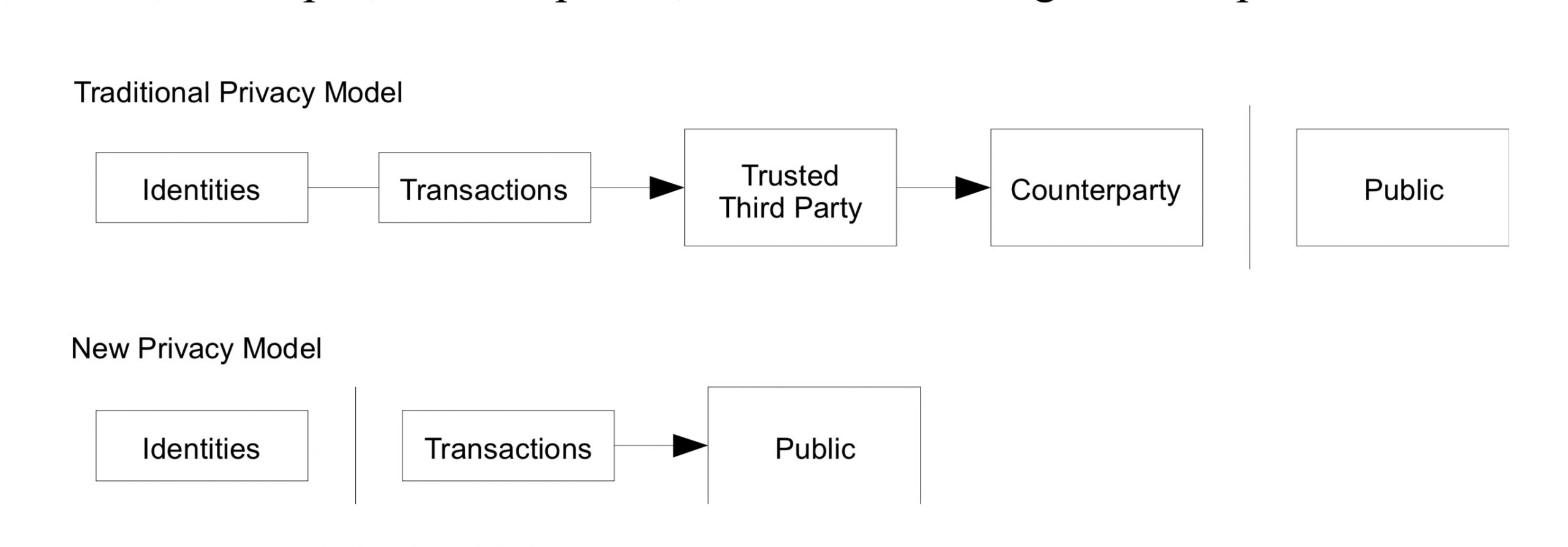
The privacy model for Bitcoin is different from traditional finance. Actually, the Bitcoin whitepaper has a nice diagram for this:

As you can see, in the traditional world of finance, transactions are shielded from public view, but “trusted third parties” know everything. Those trusted parties include banks, credit card companies, and so on.

In the Bitcoin model, the public can see all transactions, but there is no identity that is required to use the network. But in practice, can analysts use heuristics and algorithms to uncover who is behind certain transactions?

In many cases, they can. For example, if you withdraw Bitcoin from an exchange to your own wallet, the exchange knows who you are. If you then send the coins from your wallet to someone else, the second transaction can also be assumed to be from the same person.

There are several methods available if you want to make your Bitcoin transactions more private. One is to first exchange your coins for another coin that offers better privacy features (such as Monero or Bitcoin Cash), and then exchange them back to BTC.

  1. How are Bitcoins taxed?

Tax law is complicated and varies widely based on jurisdiction. I am not a tax professional and you should always seek professional tax advice when it comes to finances.

That said, it appears taxes on Bitcoin are not particularly different from other assets. When you sell Bitcoins, it is generally a taxable event and taxes are owed on the profits. Unrealized profits are generally not taxed (for example, if you hold coins and don’t sell).

  1. Where can you spend Bitcoins?

You can spend Bitcoins and other cryptocurrencies anywhere they are accepted. Often, online shops offer more cryptocurrency adoption than retail settings. One great place to find stores that accept crypto is map.bitcoin.com.

Another option is to get a crypto-based debit card. For example, this one from Bitpay. This allows you to load your coins and spend them anywhere debit cards are accepted (which is basically everywhere).

What do you think about the eight beginner questions answered? Let us know what you think about this subject in the comments section below.

The post 8 Beginner Bitcoin Questions Answered appeared first on Bitcoin News.


via Jonald Fyookball

Wednesday, December 16, 2020

21M Bitcoin and the Promise of Scarcity

In Bitcoin, the promise of a limited supply is great. This was one of the biggest things that initially appealed to me when I heard about Bitcoin. “No more than twenty one million bitcoins will ever exist!” But can this promise be kept in the long run?

Has the Promise Already Been Broken?

Some would say that Bitcoin’s scarcity has already been violated since forking creates multiples of the 21m coin limit, with each chain’s token commanding a different market price. But setting aside this concern over forks, let’s focus on a more modest goal: Can even one bitcoin chain (such as BCH) strictly maintain its issuance schedule over the next hundred years or longer?

The issue is that cryptocurrencies are based on software, and software can always be changed. Some have questioned if Bitcoin’s issuance schedule can maintain security on either Bitcoin or Bitcoin Cash in the coming decades, but we’ll deal with that question later. First, let us examine if it’s likely or not for users to even agree on what is already in place.

Phrases like Bitcoin’s “social contract” or “economic policy” get thrown around a lot, but what do they mean? In a word: change. Any major change to how Bitcoin works is often equated with a modification to the core contract or policy.

21M Bitcoin and the Promise of Scarcity

Bitcoin Isn’t Set in Stone

Since Bitcoin is based on software, the only real agreement contract, or policy, is a de-facto standard in which everyone agrees to run software with the same rules as everyone else. This purportedly makes Bitcoin “hard to change” and there may be quite a bit of truth to that. However, we know that these social agreements are not set-in-stone revelations sent by the gods. Inevitably, the winds of change blow. Disagreements brew. Fresh actors can enter the ecosystem. Software developers can create new rules.

This leads to a range of possibilities. One possibility is that long-revered tenets of the “social contract” may be cast aside, even if popular. Popularity, in the first place, is heavily influenced by the public discourse, which in turn may be influenced by disinformation and propaganda. We saw this play out during the BCH/BTC fork of Bitcoin.

Forks are the free and fair mechanism by which Bitcoin resolves irreconcilable differences. Regardless of how manipulated the news may be, the market provides an open-ended and continual mechanism that determines the value of the tokens on competing blockchains.

Upon reflection, it seems that “social contracts” and such are more wishy-washy than we would like them to be. Leading up to the BCH/BTC fork, many Bitcoiners simply assumed that, “of course”, the blocksize would have to be raised.

But those were the assumptions of the early community, and opinions change over time. The famous “overton window” is one way of looking at some of the dynamics involving changes of public opinion. An idea can be radically unthinkable at first, but over time see itself become at least debatable, and finally commonly accepted.

Investors often buy coins with the presumption that the network rules are going to be there for the long term, but this isn’t so; the rules of a ledger can change at any time, at least in theory.

In practice, there are checks and balances built into crypto. A change of rules is considered a fork, and forks generally only happen at specific pre-scheduled times. Developers cannot just publish “any code they want” because the miners won’t necessarily run it. And even if they do, if there is any subset of the community which prefers to use the old software (or an alternate software), then the fork becomes contentious, leading to a chain split.

This splitting mechanism protects investors, who automatically get coins on both sides of a split. Although it should also be said that a split isn’t always a net positive outcome for investors. For example, if a split causes a community to lose too much network effect, then the sum value of the coins post-fork may be less than the pre-fork price.

21M Bitcoin and the Promise of Scarcity

Therefore, we can conclude that there is never a guarantee to the continuation of any blockchain’s rules. The best we can do is rely on rules that seem to have some stability, and enjoy a measure of hope that the rules we cherish the most will continue on in some form.

Even if Everyone Agrees, is Zero Inflation Achievable?

Blockchain governance questions notwithstanding, the next issue that confronts us is: Is it economically feasible to keep the original Bitcoin issuance schedule in place in the far future, even as block rewards tend toward zero?

A corollary question is: are transaction fees alone going to be sufficient to secure the blockchain in the future? (This question can be asked of both Bitcoin BTC and Bitcoin Cash BCH).

One point of conflict in the BTC/BCH split dealt with this question specifically. The BTC Core developers argued that without capping the supply of block space, fees would be too low. By instead limiting the transaction capacity, this creates a fee market and thus sustainable levels of security, assuming users will continue to pay the high fee rates on the BTC chain, rather than use an alternate blockchain.

In practice, this theory has been demonstrated to be true, at least to a degree. We have seen Bitcoin blocks with fee totals comparable to (and in some cases exceeding) that of the block reward subsidies. We have also seen some willingness in the market to keep using BTC regardless of the high fees.

Interestingly, the fixed supply of the block space for transaction plays into this demand-supply equation as demand sits just below supply. You might expect demand to completely collapse, but it looks like the theories that people will pay more for transactions (because they are on the BTC chain) has some truth to it in practice.
Of course, that is only true based on a few years of data and it could change at any point in the future; for example, if crypto users decide they aren’t getting enough for their money. That seems somewhat unlikely at the moment; currently BTC is used primarily for speculation and as an inflation hedge, so its users do not need fast or cheap transactions.

The Unusual Case of Bitcoin BTC


At the same time, BTC seems to depend more on its network effect for investor dollars, rather than the actual functionality it allows. The price of any coin is based both on its network effect as well as its functionality, so this is not unusual in and of itself. But, BTC is the only coin I am aware of that has intentionally high fees. While this theoretically does help address the fee problem, it is unclear how long BTC can maintain this economic policy without turning off users and investors.

The other approach to fees is the original one: Have tons of transactions and thus keep fees relatively low but make up for it in volume. As Satoshi said “I’m sure that in 20 years there will either be very large transaction volume or no volume”.

Bitcoin Cash is following the original design of Bitcoin in terms of keeping fees low. But how is it working? So far, not great. That’s because there hasn’t been any real growth in the number of BCH transactions. But again, it is really too early to say. Bitcoin Cash may see an explosion of growth at any point in the next several decades.

The idea in Bitcoin Cash is you want to have a large number of transactions. But what if that doesn’t happen quickly enough? One other relevant factor is the price of the coin. If the coin price keeps doubling every four years, then the security level remains unchanged in dollar terms.

Both rising coin prices and rising transaction count can help. Either of these things can offset the diminishing block rewards. But what if neither is sufficient? That seems like it’s the worst-case scenario for Bitcoin playing out, but not everyone believes this is so unlikely. There are some in the crypto community who believe that the fixed supply model is simply not achievable.

Some coins, like Ethereum and Monero avoid this problem with the use of a so-called “tail emission”, which means block rewards will continue forever. While the block rewards found in advanced years are planned to be small, since they go on, the coin cannot advertise itself as having a fixed supply.

What other remedies and solutions exist? One simple idea is just for miners to raise fees on their own. It is certainly possible for miners to do that without a fixed block size. If the developers can enact an economic policy, the miners can do the same.

Of course, this runs into the same issue of fees getting too high for the chain to reliably support the “peer to peer cash” usage, but perhaps there is a market-driven sweet spot where fees can rise for larger transactions while still allowing cheap or even free transactions. In that scenario, obviously the existing pricing-by-kilobyte fee scheme would have to be overhauled.

Going Beyond Proof-of-Work

Beyond the straightforward remedies of higher prices, more transactions, or higher fee rates, increasing security would start to involve looking at more esoteric and radical changes to the technology. Proof-of-work is a powerful tool, but has the limitation that it requires a majority of the network to be honest. This is more of an issue on a minority chain like Bitcoin Cash that shares its hashing algorithm (SHA-256) with BTC.

For years, Bitcoiners have loosely discussed adding some kind of “proof of stake” element to Bitcoin security. In recent years, there have been many interesting developments in crypto technology and consensus mechanisms.

For example, the Avalanche coin (AVAX) brings a new method of achieving distributed consensus. And some have discussed trying to bring elements of this technology over to Bitcoin Cash in an attempt to “bolt it on” to the existing PoW security.

But, it should be noted that all these schemes are ultimately variations of Proof-of-stake, because they require coin holders to participate and provide security based on their holdings.

The ultimate goal of any such scheme would be to ensure that an attacker had to have both 51% of the hashpower AND 51% of the circulating supply. It doesn’t seem like we can do better than that, at least on the surface, if “work” and “stake” are the two fundamentals at play. But this would provide quite an increase in protection.

A less invasive method may be to use coin age as a determinant in qualifying a block for having sufficient work done. This idea was first proposed by Gavin Andressen but hasn’t received much discussion. However, I think it would work well if implemented as overall coindays of the blocks’ transactions. Other schemes involving both coin age plus coin days offer different properties and tradeoffs.

Still more extreme measures can be implemented, such as using time based delay penalties for re-org protection, which I had proposed last year. The idea would be that malicious attack chains wouldn’t be recognized as valid if there was a significant delay between when a node received the block and when it received a competing block of the same height.

But this kind of scheme (and re-org protection schemes overall) is less robust than pure nakamoto consensus. It is possible for an attacker to cause a chain split if alternate blocks are sent to different parts of the network with precise timing. It is also theoretically possible for some internet outtage to create a similar situation. Not to mention that new nodes coming onto the network and syncing do not have knowledge of these time delays. This is sometimes referred to as “weak subjectivity”.
In general, resolving these kinds of potential chain splits caused by impure consensus schemes would involve some centralization — for example manual pool coordination in the event of a chain split attack.

For Now, Business as Usual

I think the bottom line is that nothing is really certain just yet about how the Bitcoin experiment will continue to play out. It has certainly surprised us so far, and may continue to hold many surprises in the future. It’s too early to tell if some or all of the “promises” will come true. We have years or decades to continue researching and observing how things will unfold. The security of the blockchain is something we will keep eye on, but we still have time.

What do you think about the 21M limit in Bitcoin? Share your views in the comment section below!

The post 21M Bitcoin and the Promise of Scarcity appeared first on Bitcoin News.


via Jonald Fyookball

Monday, December 14, 2020

Chaintip Creator Unveils New Tipping Tool Sharetip

Chaintip Creator Unveils New Tipping Tool Sharetip

Tipping internet users with cryptocurrency, particularly Bitcoin Cash, seems like a great way to spread adoption. The creator of one popular tipping tool is cooking up something brand new.

Self-Serve Tipping

It’s called Sharetip and I had the opportunity to try it. I tipped someone Bitcoin Cash on Medium and it was pretty smooth. Basically, it’s like a self-serve tipping tool that you can use on any platform. Imagine tipping on Youtube, Twitter, everywhere. And it is difficult to censor because the user notifies the creator themselves, rather than a bot. At news.Bitcoin.com, we got the inside scoop from Sharetip’s creator and asked some key questions

Jonald Fyookball (JF): First of all, can you tell us who are and how you got involved with Bitcoin and Bitcoin Cash?

Tibanne (Sharetip’s creator): I’m Tibanne, a Reddit name I made up to reply ‘meow’ to various bitcoin-related posts, and then later I adopted it as an anonymous nickname. I got involved with Bitcoin in early 2014 after the $1200 top Bitcoin bubble. When scaling was required to keep Bitcoin usable, I sided with the people (I believe it was the majority at the time) who wanted to up the block size limit in the short term while a scaling solution was found in the long term. It’s hard to know exactly why BTC was co-opted at the repository level.

My current two hypotheses are 1) certain devs got bought out by more powerful people wanting to keep crypto on the sidelines, and 2) certain devs got greedy, forming the for-profit company Blockstream, which aims to profit by moving transactions off the base layer and onto their own (Liquid). In either case, well-meaning devs were pushed away and their access to the core Bitcoin repository was blocked.

Bitcoin Cash is Bitcoin to me as it retains the property of globally affordable, high confidence transaction sending.

Chaintip Creator Unveils New Tipping Tool Sharetip

JF: Your first tipping project was Chaintip. What inspired it?

Tibanne: I believe Chaintip was the first on-chain tipping bot. While there existed tippr (a custodial bot), I thought that making yet another custodial tipping bot was a bad idea and that an on-chain option would be preferable as a single hack wouldn’t put everyone’s balances in jeopardy. Chaintip links user’s addresses to their social accounts and then forwards tips to those addresses meaning that each user is always in control of their funds both before tipping and after receiving a tip. There is no concept of a ‘balance.’

JF: What about your new tool, Sharetip. How is it different from Chaintip?

Tibanne: For Chaintip to operate on a platform (Reddit, Github, and Twitter currently), an @chaintip user needs to be created on the platform and the code which speaks to that platform’s API needs to be written to make the bot function on the platform. While convenient to use, there are sometimes communication channel obstacles that need to be worked around. For example, the @chaintip bot on Twitter has to communicate publicly with the tippee because it’s not able to DM them. Additionally, were the bot to ever be banned by the platform it operates on, that would be the end of it on that platform”. The initial thinking behind Sharetip started when you asked me about two years ago how Chaintip might be extended to tipping on Youtube.

Sharetip is an attempt at making Chaintip much more prevalent by allowing people to tip content hosted at any URL and it’s not at the mercy of being shut down by another platform. Sharetip is not a bot user on other platforms, but rather it’s a platform itself. An external account (say the Twitter account of a news article’s author) is linked to the content to be tipped (the news article) and the creator of that content claims the tips to the content by proving they own the external account.

Chaintip Creator Unveils New Tipping Tool Sharetip

Sharetip currently assumes a totally altruistic motive (give without expecting anything more in return), but should creators request that some content is locked until tipped a minimum amount, or that some content they upload and make private can only be accessed by subscribers, this functionality could easily be incorporated.

This would allow Sharetip to compete in function with existing platforms like Patreon / OnlyFans / Ko-fi and others like them with the extra advantage of being able to bring in new users through Sharetip’s unique tip-anything-anywhere mechanism.

JF: Do you see tipping as a good way to spread adoption of Bitcoin Cash and crypto? What have you observed in terms of the popularity and spread of this technology?

Tibanne: Yes, I think it’s a great way to spread the adoption of Bitcoin Cash and other cryptos. Saying that, I don’t think that tipping should be done for this reason. There was a good article on the woes of Bitcoin tipping while a service called ChangeTip was gaining in popularity. Sharetip shares some parallels with ChangeTip, but it’s non-custodial, and running it does not depend on it making much profit. So I feel that I’ve managed to avoid most, if not all, of the pitfalls mentioned in this article.

It’s sad to say, but cryptocurrency is mostly spread through new highs and the resulting speculation and less through excitement about real-world use cases. Hopefully, Sharetip can right this slightly. I must give a shout out to read.cash here as well as it’s proven to be a great use case.”

JF: Last question: What are you most excited about in bitcoin cash/crypto right now and what do you hope to see in the next few years?

Tibanne: I get excited when the properties that crypto bring to money are used in real-world applications. Things like the Bitcoin.com wallet, OpenBazaar, Blockchain.poker, Memo, and SLP excite me. Bitcoin.com brings a lightning-fast wallet which allows anyone to take part in a global economy without relying on banks. OpenBazaar removes middlemen from trade. Blockchain.poker removes the need for payment processors to manage the deposits and withdrawals. Memo allows for an uncensorable dialog. Finally, SLP brings back to Bitcoin what colored coins promised many years ago. I’m most excited to see these used to allow equity of new startups to be traded without restriction.”

What do you think about tipping tools like Sharetip? Share your views in the comments section below.

The post Chaintip Creator Unveils New Tipping Tool Sharetip appeared first on Bitcoin News.


via Jonald Fyookball