Showing posts with label C. Edward Kelso. Show all posts
Showing posts with label C. Edward Kelso. Show all posts
Thursday, October 11, 2018

Hundreds of ICOs Being Secretly Investigated by SEC, Claims Report

Hundreds of startups are reportedly being “secretly” targeted by the U.S. Securities and Exchange Commission for their involvement with initial coin offerings. Companies that participated in ICOs are now scrambling to clarify whether their token constituted a security, and, if so, whether it was properly registered with or exempted by the SEC.
Also read: Europe, Japan and the ‘Drug’ of Quantitative Easing
SEC ‘Tightens the Noose’ on Startups That Used an ICO
 Yahoo Finance and Decrypt claims that “Hundreds of startups that did token sales are finding out they’re in violation of securities law— including many that were sure they did it the right way.”
The auspicious beginning of the present year came with subpoenas, characterized by the Commission as informational in scope. There appears to be more than mere cataloging of the crypto landscape, as “the Securities and Exchange Commission has significantly widened its crackdown on certain initial coin offerings, putting hundreds of cryptocurrency startups at risk.” The agency “has returned to many of those companies, and subpoenaed many more—focusing on those that failed to properly ensure they sold their token exclusively to accredited investors,” Decrypt notes.
Formal litigation can be costly, taxing a given regulatory bureaucracy’s workload and clogging up courts and judges. It also appears the agency is at first moving to have suspected companies in violation settle. “In response,” Roberts explains, “dozens of companies have quietly agreed to refund investor money and pay a fine. But many startups that have been subpoenaed say they are left in the dark struggling to satisfy the SEC’s demands, and are uncertain of how others are handling it, according to conversations with more than 15 industry sources.”
IPOs Died in the US, Startups Resorted to ICOs
Compounding matters is how this widespread investigation was unearthed: anonymous sources due to the fact the agency formally “restricts them from discussing the matter,” Decrypt insists. Initial coin offerings are a twist on initial public offerings, IPOs, which have been effectively strangled out of existence in the United States within just the last few decades. Legacy American stock markets, for example, have something close to half the number of public companies listed as they might have otherwise.

Saddled with regulations, barriers to entry and countless legal frictions only hordes of lawyers can battle, smaller companies have been priced out of the IPO model for bringing a business to public market in the US. Instead, those that might have participated at one point wait in the queue at merger and acquisition wings of established juggernauts. That, or they leave the US altogether and try their hand in places such as Hong Kong, which has, sure enough, seen an IPO boom recent years.
ICOs, then, are at least part of a response to that environment. Unaccredited investors, with minimal friction, have accomplished in ICOs at least two things most analysts agree: financial democratization and innovation, but at the expense of a wildcat space filled with scams. A startup can in a manner of clicks become presentable enough to sell a proprietary digital token quickly.
A Game of Definitions
About a month after subpoenas were sent by the agency, Chairman Jay Clayton seemed to make the regulator’s opinion going forward very clear. During a Senate hearing on the subject of cryptocurrencies, Clayton stated flatly, “I believe every ICO I’ve seen is a security.” But what constitutes an ICO then becomes the question if every initial coin offering is subject to their jurisdiction. The agency “does not care” about semantics, the report scolds, even though some “companies that did ICOs called their offering something else, such as a ‘utility token’ or a ‘SAFT’ (Simple Agreement for Future Tokens, an ICO method in which investors buy a reservation for tokens yet to be launched).”

Due to the cat and mouse nature of the space, “It is hard to say precisely how many ICOs occurred during the past four years,” Decrypt acknowledges. Thousands for sure, and more than “$20 billion has been raised in ICOs to date, but the ICO boom peaked in January 2018. Concerns over the legality of token sales have had a chilling effect.”
However, it is well known that all US firms anywhere near to offering a security are governed by the SEC in one form or another. And the agency does offer a formal exemption which asks participation be limited to vaunted “accredited investors” who earn more than $200,000 per year, for two years, and hold a net worth of at least $1 million – factors that probably led the company to seek an ICO in the first place. At that same Senate hearing, Clayton was asked how many had sought SEC approval. The answer came back ominously: almost none.
Will the SEC sorting out ICOs lead to a positive outcome for crypto markets? Let us know in the comments below.
Images courtesy of Shutterstock.
At Bitcoin.com there’s a bunch of free helpful services. For instance, have you seen our Tools page? You can even look up the exchange rate for a transaction in the past. Or calculate the value of your current holdings. Or create a paper wallet. And much more.
The post Hundreds of ICOs Being Secretly Investigated by SEC, Claims Report appeared first on Bitcoin News.
via C. Edward Kelso
Wednesday, October 10, 2018
Europe, Japan and the ‘Drug’ of Quantitative Easing
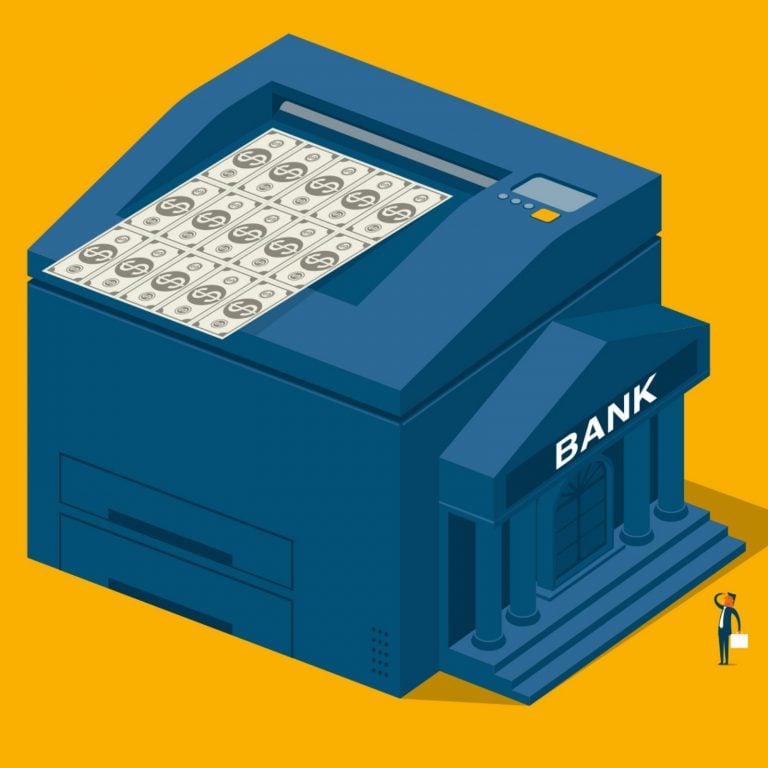
Last month, news.Bitcoin.com examined the problem of quantitative easing (QE) and its impact on the U.S., and how such policies have spread to the rest of the world. This month, we continue to drill down on the phenomenon of governments printing trillions of dollars worth of fiat currency simply by pressing buttons on their computers. Value has been stolen from average people, flowing upward to the extremely rich. Now two of the world’s most important economies, Europe and Japan, appear to be considering a break from a policy habit that has proven to be particularly addictive for politicians and banks.
Also read: Tired of Bank Bailouts and Hyperinflation? Bitcoin Offers Something Different
Europe to Break the QE Habit
According to the European Central Bank (ECB), “Monthly net purchases of public and private sector securities currently amount to €30 billion on average. On June 14, 2018, the Governing Council stated that it ‘anticipates that, after September 2018, subject to incoming data confirming the Governing Council’s medium-term inflation outlook, the monthly pace of the net asset purchases will be reduced to €15 billion until the end of December 2018 and that net purchases will then end.’”

The carnage wreaked by such influxes of capital are numerous. After following the Americans to Southwest Asia, bouncing rubble throughout two decades of war, the resulting wave of migrants seeking relief ended up at Europe’s own doorstep. Such policies have pushed real estate valuations to unprecedented levels, and the continent’s inhabitants seem more dependent upon government largess than ever before. If the previous century is any guide, economic frailty combined with social upheaval does not usually end well in Europe.
The ECB continues to detail the massive amounts of public wealth that are routinely stolen, which it describes as “purchases.” What it is actually doing is printing new debt money out of thin air, in the billions. Every month. How the public can accept this is a mystery, but the explanation is probably simply that few people understand the havoc these “purchases” afflict on regular citizens.
The previous “monthly purchases were conducted at average paces of: €60 billion from March 2015 until March 2016; €80 billion from April 2016 until March 2017; €60 billion from April 2017 to December 2017.” Such numbers are difficult to put into perspective. The term “massive” hardly seems to do them justice.
Japan Will Struggle to Sober Up
“At BOJ policy meetings,” Wolf Richter wrote in a recent post for Wolf Street, “concerns have been voiced over the ‘sustainability’ of the stimulus program, according to the minutes of the July meeting, released on Sept. 25. So the BOJ staff ‘proposed measures to enhance the sustainability of the current monetary easing while taking into consideration, for example, their effects on financial markets.’”
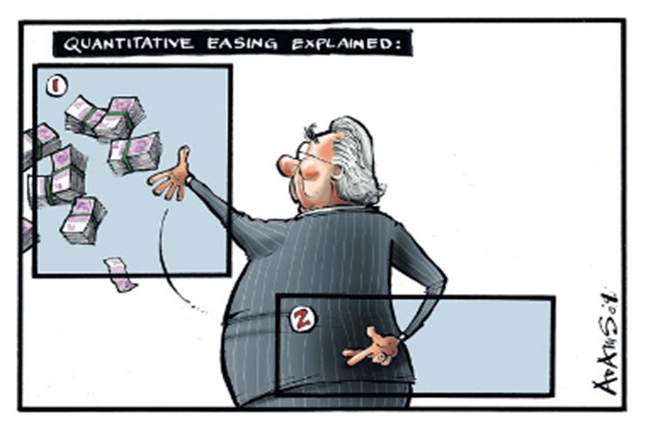
The BOJ has stressed a kind of “flexibility” going forward so that it can “continue to buy Japanese government bonds (JGBs) in ‘a flexible manner’ so that its holdings would increase by about 80 trillion yen a year,” Richter explains. “But this is precisely what has not been happening, in line with this ‘flexibility.’ Over the past 12 months, the BOJ’s holdings of JGBs rose by ‘only’ 26.2 trillion yen — not 80 trillion yen. And they declined in September from the prior month.”
Japan will have a very difficult problem sobering up, however. Literally 100% of its GDP is comprised of assets on the BOJ’s balance sheet, some 540 trillion yen worth. At its worst, the egregious U.S. hogged a quarter of its own GDP. “Japan, by far the most over-indebted country in the world in relationship to its economy, has decided that there will be no debt crisis. A debt crisis would force Japan to brutally cut its budget for social services and raise taxes by large amounts to make ends meet.” It might be simply too late for Japan.
The Answer Waiting to be Discovered
Quantitative easing and similar policies have effectively driven cypherpunks toward a new form of money. They wished to usurp gold, the ancient metal so corrupted by modern central banks it had become a major liability, and one easily confiscated should the worst happen. Yet hard money, as it is known, had some lessons: relative scarcity, divisible, sourced independent of governments. Bitcoin was the answer, of course, to the sound money paradox as it related to gold and the age-old problem of those in power with too much control.
It is probably overly hopeful to assume immediate massive adoption throughout Europe and Japan will take place in the wake of wealth grabs such as QE, but the evidence is there insofar as government control of money is concerned: Currency is too important to leave to politicians and banks, and is best left to the individual.
What are your thoughts on quantitative easing? Let us know in the comments below.
Images courtesy of Shutterstock.
At Bitcoin.com there’s a bunch of free helpful services. For instance, have you seen our Tools page? You can even look up the exchange rate for a transaction in the past. Or calculate the value of your current holdings. Or create a paper wallet. And much more.
Op-Ed disclaimer: The opinions expressed in this article are the author’s own. Bitcoin.com does not endorse nor support views, opinions or conclusions drawn in this post. Bitcoin.com is not responsible for or liable for any content, accuracy or quality within the Op-ed article. Readers should do their own due diligence before taking any actions related to the content. Bitcoin.com is not responsible, directly or indirectly, for any damage or loss caused or alleged to be caused by or in connection with the use of or reliance on any information in this Op-ed article.
The post Europe, Japan and the ‘Drug’ of Quantitative Easing appeared first on Bitcoin News.
via C. Edward Kelso
Monday, October 8, 2018
Salt to Offer Crypto-Backed Loans in 7 Global Markets, 15 More US States
Salt, a cryptocurrency-backed loan service, has announced plans to launch operations in seven new jurisdictions throughout the world, while offering its services in 15 more U.S. states. It will also include litecoin (LTC) among its offerings, while providing more competitive interest rates and removing loan caps.
Also read: Bitcoin Price: Wall Street Optimistic, Enthusiasts Pessimistic According to Fundstrat
Expansion into New
International Markets
Salt revealed it is opening offices in states such as New Jersey, Massachusetts, Washington and Texas, bringing the total to 35 overall. It will also launch operations in Brazil, Hong Kong, Switzerland, Vietnam, Bermuda, Puerto Rico and the United Arab Emirates. The move follows the company’s expansion into 20 U.S. states in August, according to a company blog post.
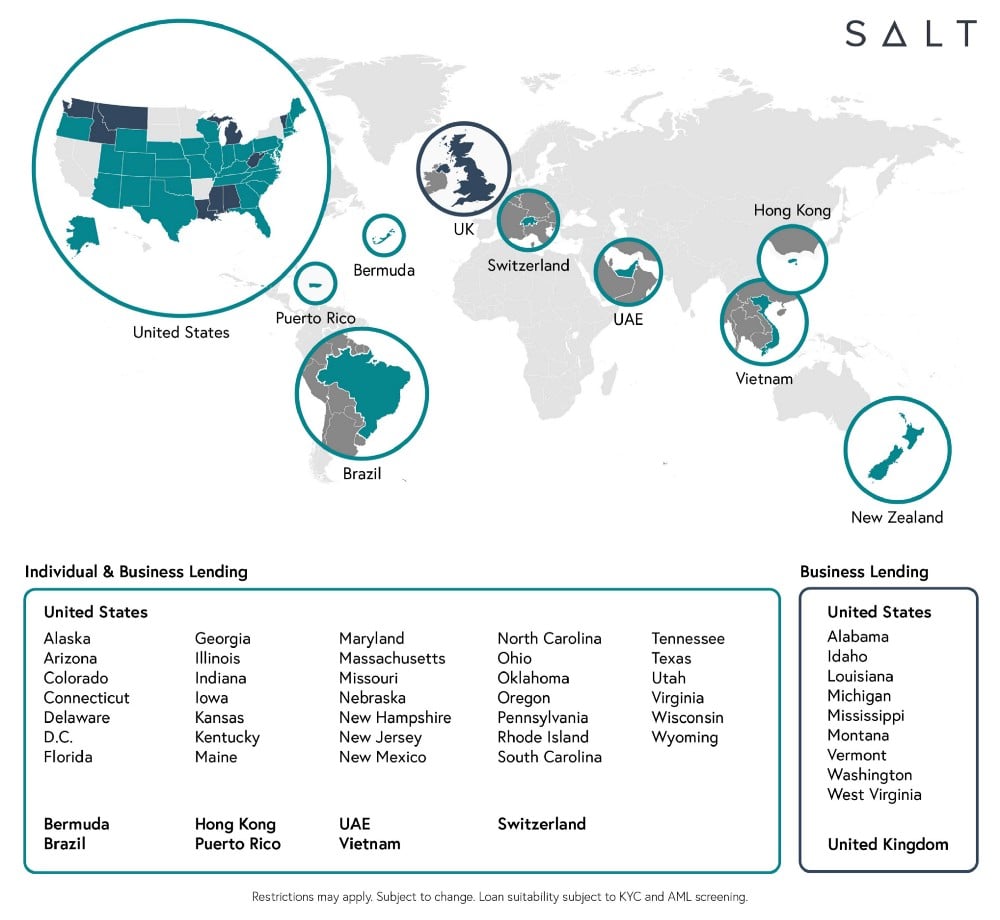
The Denver-based startup came to market in an initial coin offering (ICO) in August 2017, during last year’s boom. It is targeting enthusiasts who would rather hold their crypto than sell it into fiat. During an extended bear market, such services might become invaluable, should trends reverse in the future.
The company does offer consumer-level loans, but its main focus continues to be acting as a “liquidity provider for large crypto investors including individuals, mining operations, exchanges and other institutions in the blockchain ecosystem,” it explained in a press release. “With a primary goal of serving large clients, (offering) live portfolio valuation, around-the-clock global support, a range of competitive rates, flexible loan terms, and a proprietary custody solution enables it to meet the needs of individuals and businesses alike, making it the ideal loan solution for a wide range of clients.”
Critics: Just Another Bank
Loans against the US dollar carry interest of 5.99% when below $75,000, with rates doubling for loans up to $25 million. “For loans greater than $25 million, tailored options are available. Loan amounts and interest rates vary by jurisdiction.” Salt also claims to offer “no origination fees, no prepayment fees, no servicing fees, no closing costs,” and since they’re “one of the few companies lending in fiat currency,” Salt can “increase loan access and provide a multifaceted loan service to our customers across the world.”
 The combined news appears to have moved Salt’s proprietary token, SALT, up considerably. At one point it jumped 55%, with over $20 million flowing to the project — a 1,478% increase over previous levels. Analysts suggest the addition of litecoin to its bitcoin core and ether secure loan offerings drove speculators to pump the 109th-ranked token by market capitalization.
ICO proponents typically tout the crypto-backed loan firm as an example of success. But critics of the platform complain Salt isn’t offering much more to the ecosystem than aping traditional banking mechanisms, enabling yet more fiat involvement — an aspect some enthusiasts find antithetical to cryptocurrency. It also doesn’t help matters when early in 2018 the company CEO suddenly bailed, leaving more than a few to wonder aloud if a classic ICO exit scam wasn’t underway. The fact the project has a token (ERC20-based, with a token supply of 120,000,000 and 54,507,718 circulating) is also troubling to some who view such a move as a pure money grab, rather than something offering any real utility.
Do you expect to ever make use of crypto-backed loans? Let us know in the comments below.
Images courtesy of Shutterstock, Salt.
At Bitcoin.com there’s a bunch of free helpful services. For instance, have you seen our Tools page? You can even look up the exchange rate for a transaction in the past. Or calculate the value of your current holdings. Or create a paper wallet. And much more.
The post Salt to Offer Crypto-Backed Loans in 7 Global Markets, 15 More US States appeared first on Bitcoin News.
via C. Edward Kelso
Saturday, October 6, 2018
Bitcoin Price: Wall Street Optimistic, Enthusiasts Pessimistic According to Fundstrat

44 percent of those surveyed on crypto Twitter believe the price of bitcoin core (BTC) has a ways to go before finding bottom, while over half of Wall Street and institutional investors seem to believe BTC’s bottom has been reached. The poll was conducted by Fundstrat, comparing the views comprised of 25 Wall Street related institutions against those of 9,500 respondents on Twitter.
Also read: Hong Kong-Based Crypto Exchange Coinex Pays Interest in BCH

Fundstrat: Wall Street is Optimistic While the Ecosystem Remains Sour on BTC’s Price
Over the period of a week in late September of this year, Fundstrat conducted a poll between institutional or Wall Street investors and Twitter respondents, who might be considered the broader spectrum of crypto enthusiasts. While not particularly scientific in the strictest sense, and therefore can be interpreted a number of ways, it does provide some counter-intuitive data.
What jumps out to most keen observers of the space is the conclusion Wall Street is more optimistic about BTC prices than crypto Twitter. Fundstrat found 54 percent of Wall Street respondents were fairly sure the world’s most popular cryptocurrency has hit its price bottom. Crypto Twitter, however, over 9,000 strong, was decidedly less hopeful: only 44 percent felt BTC was at bottom, suggesting there might be a ways to go yet. And by the end of 2019, institutions were more likely to predict BTC hitting $15,000 (57%) compared to just 40% crypto Twitter’s respondents.

Central Banks and Emerging Markets Are Macro Factors Impacting Future of Crypto
25 institutions received ten questions, while Twitter got a version of those whittled down to just six, eliciting 9,500 responses. More obvious takeaways include how both genres polled agreed ‘macro factors’ impacting crypto going forward are central banks and emerging markets, which ranked 1 and 2 respectively. Institutions, however, view politics as having a greater impact compared to their crypto Twitter counterparts.
Alternative token ripple (XRP) made an appearance within the poll. Of more than a dozen choices offered, nearly six out of ten institutions chose BTC as their favorite. Crypto Twitter picked XRP as their favorite (46%). Curiously, though chosen as its preferred coin, 31 percent of Twitter believes XRP makes the “least sense” of any crypto. No institution chose XRP as their favorite.

Other findings of interest include how institutions polled were decidedly bullish on BTC’s price rising, with 57 percent believing it will be between at least $15,000 to “the moon” by next year’s end. And should the US economy fall to recession, only 59% of crypto Twitter believed cryptocurrency prices would rise, while institutions remain more optimistic with 72% answering crypto could very well increase in price during economic down times.
Are you optimistic about BTC’s price? Let us know in the comments below.
Images courtesy of Shutterstock, Fundstrat.
At Bitcoin.com there’s a bunch of free helpful services. For instance, have you seen our Tools page? You can even look up the exchange rate for a transaction in the past. Or calculate the value of your current holdings. Or create a paper wallet. And much more.
The post Bitcoin Price: Wall Street Optimistic, Enthusiasts Pessimistic According to Fundstrat appeared first on Bitcoin News.
via C. Edward Kelso
Friday, October 5, 2018
China-Based Crypto Exchange Coinex Pays Interest in BCH
Crypto exchange Coinex will pay out long-term dividends, interest, in bitcoin cash (BCH) for coinex token (CET) holders, according to its website announcement. “If your CET holdings are on Coinex, we’ll calculate the dividends into BCH and allocate directly to your accounts,” the company explained.
Also read: Bitcoin Cash Speaker Series II Brings Leading Bitcoiners Together
Coinex to Pay Out Long-Term Interest in Bitcoin Cash
What began as a widely circulated subreddit rumor appears to be confirmed. Cryptocurrency exchange Coinex will be paying out long-term dividends, or interest, in BCH for their CET holders, according to the company’s website.

China-based Coinex, owned by mining giant Bitmain, is a relatively young exchange, offering a range of crypto assets to be traded against the likes of BCH, bitcoin core (BTC), ether (ETH), and tether (USDT). It has a native token, CET, which can be traded against the others as well. Market makers are not charged a fee, while market takers pay a somewhat low 0.10% on trades. Coinex also processes over-the-counter trades and offers referral rewards. They employ a transparent method of token distribution, as all transaction fees collected and how they are distributed are displayed on the site in real-time.
Monthly Allocation
As of the beginning of this month, “Coinex will release ‘Lock & Mine CET’ and execute [the] ‘Long-term dividend allocation plan,’” the company explained. Holding a minimum 10,000 CET is required to receive BCH dividends, and none of the tokens may be acquired through mining – only ‘released’ CET qualify toward the offer. “Coinex will take a snapshot at 0:00 (UTC) everyday and allocate rewards of the previous day according to the snapshot results.” 
“To guarantee the sustainable development of CET and interests of CET holders,” Coinex continued, “we decided to release a long-term dividend allocation plan by which CET holders will continue to receive dividends after ‘Trade-driven mining’ ends.” Allocation of BCH will occur monthly, and within seven business days of a new month. As always, that date might vary still depending on exactly when final settlement occurs.
“80% of Coinex’s total revenue will be allocated to CET holders and the remaining 20% is kept for Coinex development and daily operations,” the execution plan detailed. The exchange will also use a significant portion of its revenue to “repurchase CET from the secondary market and allocate to the qualified CET holders proportionately,” and holders can determine their personal ratio by dividing held CET by the total CET in circulation.
Do dividends and interest attract you to an exchange? Let us know in the comments below.
Images courtesy of Shutterstock.
At Bitcoin.com there’s a bunch of free helpful services. For instance, have you seen our Tools page? You can even look up the exchange rate for a transaction in the past. Or calculate the value of your current holdings. Or create a paper wallet. And much more.
The post China-Based Crypto Exchange Coinex Pays Interest in BCH appeared first on Bitcoin News.
via C. Edward Kelso
Thursday, October 4, 2018
Wednesday, October 3, 2018
Bitcoin Cash Speaker Series II Brings Leading BCHers Together

Later this month, the London Bitcoin Cash (BCH) Speaker Series II will take place at Huckletree Shoreditch. It’s one of the final times representatives from Coingeek and Bitcoin.com, among other BCH enthusiasts, will meet prior to the November 15th hard fork. Though not overtly about forks, it is a chance for the public to hear thoughts from important developers and marketers about the future of decentralized digital currency.
Also read: Colombia Crypto Exchange Asks New President for Banking Help
Bitcoin Cash Speaker Series II in London at the End of This Month
Mark Hebblewhite, Head of Marketing at Coingeek.com, Gabriel Cordona, Senior BCH Developer at Bitcoin.com and Founder of Bitbox, Alex Agut & Rafael Seibane, Founders of Hand Cash, and Alejandro De La Torre, VP Business and Operations of BTC.com, are part of the lineup set for Thursday, October 25th, 6pm to 9pm, in London for the second Bitcoin Cash Speakers Series.

According to organizers at Cryptartica and Coingeek, supported by partners Bitcoin Cash Association (BCA) and Bitcoin.com, the event is “a follow-up to the first Speaker Series event. The series aims to cover the recent BCH ecosystem development and to nurture the local BCH community in London.”
Cryptartica, a co-organizer, bills itself as “early adopters of” Bitcoin Cash, and a “first Bitcoin Cash store.” They’re a “platform in which independent designers can earn cryptocurrency by turning their unique ideas into high-quality and customization products.” BCH shirts, mugs, posters, and assorted swag can all be found on their site. Coingeek, the other principal organizer, is part of the Ayre Group, and it has a news site, a Citizenship Investment Program, a BCH Mining Pool, and it routinely organizes well-attended BCH-related conferences around the world.

A Comprehensive Evening
“The first part of the evening,” organizers explain, “will focus on BCH adoption. Mark from Coingeek and Gabriel from Bitbox will discuss about how their companies/projects help spread BCH adoption.” Gabriel Cardona’s Bitbox claims to solve BCH developer redundancies, making it theoretically easier to build applications, and has over 40,000 downloads through more than 100 countries. He’s also traveling the world explaining Wormhole, a BCH way to tokenize on-chain.
The event also includes Brew Dog, “the first major brewery to accept cryptocurrency, will also speak about their experience in adopting BCH. On the second half, the focus will shift towards wallets. Alex and Rafa, founders of Handcash, will speak about their journey towards creating a user-friendly wallet.” Early this year, “Nchain Group announced they had ‘closed a deal’ that gives the company a large stake in the Handcash platform. According to Nchain, the deal was facilitated through the company’s investment arm Nchain Reaction. News.Bitcoin.com reported on Handcash this past February when the team launched its bitcoin cash beta client for Android phones. The Handcash app allows users to transact with BCH using NFC technology and the platform was created by two developers from Spain, Alejandro Pascual Agut and Rafael Jiménez Seibane,” news.Bitcoin.com detailed.

Lastly, “Alejandro from BTC.com will then close the event,” organizers explained. BTC.com is best known for its block explorer, mining pool, and a mobile and web wallet. Last week, these pages outlined a new teaming between BTC.com and Bitpay. “BTC.com has announced its wallet will enable Bitcoin Improvement Proposal 70 (BIP-70) for payment transactions, which is especially helpful between customers and merchants, becoming an industry standard of sorts. The wallet has more than one million users, and with BIP-70 they will be able to buy products from popular processing platform Bitpay, which has a $1 billion merchant market,” we documented.
Will you be attending? Let us know in the comments below.
Images courtesy of Shutterstock.
At Bitcoin.com there’s a bunch of free helpful services. For instance, have you seen our Tools page? You can even look up the exchange rate for a transaction in the past. Or calculate the value of your current holdings. Or create a paper wallet. And much more.
The post Bitcoin Cash Speaker Series II Brings Leading BCHers Together appeared first on Bitcoin News.
via C. Edward Kelso
Tuesday, October 2, 2018
Monday, October 1, 2018
Saturday, September 29, 2018
Friday, September 28, 2018
Popular Bitcoin Wallet Samourai Ditches All Government Currencies

In what could be construed as calling the casual enthusiast’s bluff, BTC maximalists at the Samourai project announced, “All fiat currency conversions have been removed from Samourai Wallet. We understand this may inconvenience some, it may even be enough to cause us to lose some users, but we believe it is fundamental that our existing and future users understand that when they transact within the Bitcoin network, when they participate in the Bitcoin economy, they are transacting with the token native to the Bitcoin network, BTC, and nothing else.”
Also read: Colombia Crypto Exchange Asks New President for Banking Help
Samourai Wallet Increases Native Languages, Gives Fiat Currencies the Boot
“0.98.87 – Welcome new international users, and saying adieu to fiat currency”, came the ad hoc title alerting users to a wallet update through Google Play and Github. The notoriously privacy-obsessed project revealed, “Samourai Wallet is now available in 12 languages with French and Chinese added in this release. These aren’t generic computer translations, these are translations by actual bitcoin users from the local region, and as such are extremely high quality and contextual.”

Languages incorporated into the platform now include Brazilian Portuguese, Bulgarian, Chinese, French, German, Indonesian, Italian, Portuguese, Russian, Spanish, and Turkish. They claim to have “already seen the side effects with installs increasing dramatically from international user bases with a native translation, usually in places where they need Samourai the most.”
And while the above will inevitably lead to more adoption, at least for their wallet, the real tension in the post came with the announcement Samourai was ditching fiat almost entirely. Nearly all cryptocurrency communities have lofty goals of creating their own ecosystem, self-supporting, self-referencing. It appears the Samourai community is tired of debate, of hoping, of dreaming for that future.
Government Money Is a Crutch
“In 2015 when we first launched Samourai Wallet,” they continued, “we reasoned that a fiat based conversion rate would be a convenient feature for users who wished to have a rough idea of what their BTC stash was worth in fiat currency at any given time. We said ‘users aren’t ready’ to give up fiat in the wallet, and we ended up including what we called the ‘Street Price’ – the fiat conversion rate as provided by exchanges and services without KYC/AML requirements – and left it at that.”

But then something happened. Veterans will tell you. BTC’s importance quickly pivoted from being its own end in exchanging goods and services to valued almost strictly in relation to how much government money it was worth. Some took it in stride, a kind of growing pain to be worked out later; others were increasingly disgusted. “In 2017 we noticed a disturbing trend within the wider community,” the post lamented. “Many news outlets, data providers, prominent persons, and innocent users started to refer to bitcoin transactions in USD terms instead of BTC terms […] We reasoned that ‘Users aren’t ready’ to give up thinking in fiat terms, and with education they would eventually change.”
Recently they realized “users will never be ready. Thinking in fiat currency terms is familiar, you likely interact with it all the time. This is precisely the reason that within the context of a Bitcoin wallet it is a crutch. We have made the decision that as of version 0.98.87 to remove that crutch.” The only concession is to independent merchants “who frequently use the [Sentinel Watch Only app] and [where] other use cases require the use of a currency conversion function.”
Is it time for all crypto enthusiasts to do the same as Samourai and ditch USD pricing? Let us know in the comments below.
Images courtesy of Shutterstock.
At Bitcoin.com there’s a bunch of free helpful services. For instance, have you seen our Tools page? You can even look up the exchange rate for a transaction in the past. Or calculate the value of your current holdings. Or create a paper wallet. And much more.
The post Popular Bitcoin Wallet Samourai Ditches All Government Currencies appeared first on Bitcoin News.
via C. Edward Kelso
Free Crypto Trading App Robinhood Available in Alaska and Oklahoma

“Alaska, thanks for bearing with us,” popular smartphone trading app Robinhood tweeted. “Trade Bitcoin and other cryptocurrencies, commission free.” Mere days after, it announced the same for Oklahoma. Residents of the two states can now trade bitcoin cash, dogecoin, ethereum, ethereum classic, and litecoin on its platform.
Also read: Colombia Crypto Exchange Asks New President for Banking Help
Robinhood Brings Free Crypto Trading App to Alaska and Oklahoma
This week Robinhood, the booming smartphone stock and crypto commission-free trading app, announced it had extended its services to the US states of Alaska and Oklahoma. Effectively, the company is gaining on being available in nearly half of the United States.

Including Alaska and Oklahoma, the 19 other states where users can try the app are Arizona, California, Colorado, Florida, Georgia, Indiana, Iowa, Massachusetts, Michigan, Mississippi, Missouri, Montana, New Jersey, New Mexico, Pennsylvania, Texas, Utah, Virginia, and Wisconsin.
The app features half a dozen cryptocurrencies, but users are also privy to legacy and institutional stock markets, charts, options, as well as up-to-the-minute data from altcoins such as Bitcoin Gold, Dash, Lisk, Monero, NEO, Omisego, Qtum, Ripple, Stellar, and Zcash.
A Year of Growing Into Crypto
The company began 2018 with a blockbuster announcement, suggesting they were moving into crypto. “Trading functionality for BTC and ETH will be released gradually in waves,” they blogged, “to Robinhood residents in California, Massachusetts, Missouri, Montana, and New Hampshire. Robinhood Crypto will be available in more states soon.”

By February, users could begin trading bitcoin core (BTC) and ether. Not too long after, the company began to inch their way into California, Massachusetts, Missouri, Montana, and New Hampshire. It has seemed all downhill from then on for the app, as it continued to gain clusters of states.
It also wasn’t too much long ago the company was valued at over $5 billion following over a quarter billion dollars in venture capital funding. Some analysts insisted at least part of that eye-popping valuation was due to Robinhood embracing cryptocurrency.
Do you think Robinhood will eventually expand into all 50 US states? Let us know in the comments below.
Images courtesy of Shutterstock.
At Bitcoin.com there’s a bunch of free helpful services. For instance, have you seen our Tools page? You can even look up the exchange rate for a transaction in the past. Or calculate the value of your current holdings. Or create a paper wallet. And much more.
The post Free Crypto Trading App Robinhood Available in Alaska and Oklahoma appeared first on Bitcoin News.
via C. Edward Kelso
Thursday, September 27, 2018
Bitpay and BTC.com Team: 1 Million Users Gain Access to $1 Billion Merchant Market

BTC.com has . announced its wallet will enable Bitcoin Improvement Proposal 70 (BIP-70) for payment transactions, which is especially helpful between customers and merchants, becoming an industry standard of sorts. The wallet has more than one million users, and with BIP-70 they will be able to buy products from popular processing platform Bitpay, which has a $1 billion merchant market.
Also read: 3D Gun File Company Reorganizes After C aody Wilson Resigns
BTC.com Wallet Users Can Now Be Connected to Bitpay Merchants
BIP-70 is a favorite of merchants because it provides for secure end-to-end communication to customers all over the world. Payments are routed and confirmed onchain. And with BTC.com users now able to safely store their private keys on its multi-sig wallet, they retain control over their coins, and have a choice of more goods and services than ever.

Sean Rolland, Director of Product at Bitpay, explained, “We appreciate BTC.com’s support for BIP-70 as Bitpay works to make Bitcoin commerce payments easier and even more secure. With BIP-70, we have seen a drop from an 8%+ payment error rate (in dollars) to a 0.27% error rate. It’s this ability to ensure correct payments using BIP-70 helps the entire industry to grow.”
Since 2015, BTC.com claims to have processed more than $5B worth of bitcoin cash (BCH) and bitcoin core (BTC) on behalf of one million users. Bitpay’s merchants, which number in the hundreds of thousands, only accept BIP-70 wallets.
It’s All About Commerce
BTC.com’s VP of Business Operations, Alejandro de la Torre, detailed, “We’re always striving for new methods and partnerships to expand the use of BTC and BCH as a currency and integrating with Bitpay is an important step towards transacting with retailers and merchants. Cryptocurrencies can begin to compete with credit card and mobile transactions by capitalizing on current inefficiencies in traditional payment processing services and extend the boundaries of commerce. Enabling customers, merchants and the Bitcoin community to utilize Bitcoin in commerce will sow the seeds for cultivating deep and sustainable growth from the whole bitcoin community.”
 Considering crypto’s extended bear market, spanning the bulk of the present year, proponents of mainstreaming have had a tough sell. Perhaps what might sway skeptical retailers is convenience of onboarding for customers (frictionless features such as no KYC or AML requirements), low transaction fees, and fast confirmation times. And while Bitpay for sure has KYC, the BTC.com wallet upgrade allows its users to tap into Bitpay’s 1% merchant fee which is more than competitive when placed against traditional credit card processors.
Atlanta-based Bitpay allows users to spend and accept cryptocurrency such as bitcoin cash (BCH), having worked for years to establish business relationships with merchants on behalf of the crypto community by way of its Visa debit card, for example. Arguably its most important feature is to mitigate against price volatility, the kind which has spooked businesses from dabbling in the ecosystem. Settlements are made in fiat, and deposited directly in the merchant’s account.
Do you think BTC.com’s new wallet will help crypto adoption? Let us know in the comments below.
Images courtesy of Shutterstock.
At Bitcoin.com there’s a bunch of free helpful services. For instance, have you seen our Tools page? You can even look up the exchange rate for a transaction in the past. Or calculate the value of your current holdings. Or create a paper wallet. And much more.
The post Bitpay and BTC.com Team: 1 Million Users Gain Access to $1 Billion Merchant Market appeared first on Bitcoin News.
via C. Edward Kelso
Wednesday, September 26, 2018
Tuesday, September 25, 2018
Vague Laws Leave Crypto Users Confused in Almost Half of the US

Justin Wales and Arnaldo Rego, lawyers at Carlton Fields, have surveyed all 50 states in the US, looking for clarity on money transmitting laws as they relate to cryptocurrencies. As adoption and general usage increases, states appear to be failing to keep up, leaving many enthusiasts to wonder if they’re committing a crime.
Also read: Square’s Big Week: Crypto Patent, Shares Leap, and Lightning Plug
In Nearly Half of the US, Crypto Enthusiasts Cannot be Sure of the Law
Of 50 US states, 12 have been judged “unclear” in terms of money laundering laws and how they relate to cryptocurrency. That’s significant due to the way enthusiasts have been prosecuted in the United States by regulators. Legal researchers from the law firm Carlton Fields examined all 50 states, and Washington, DC with regard to cryptocurrency law.
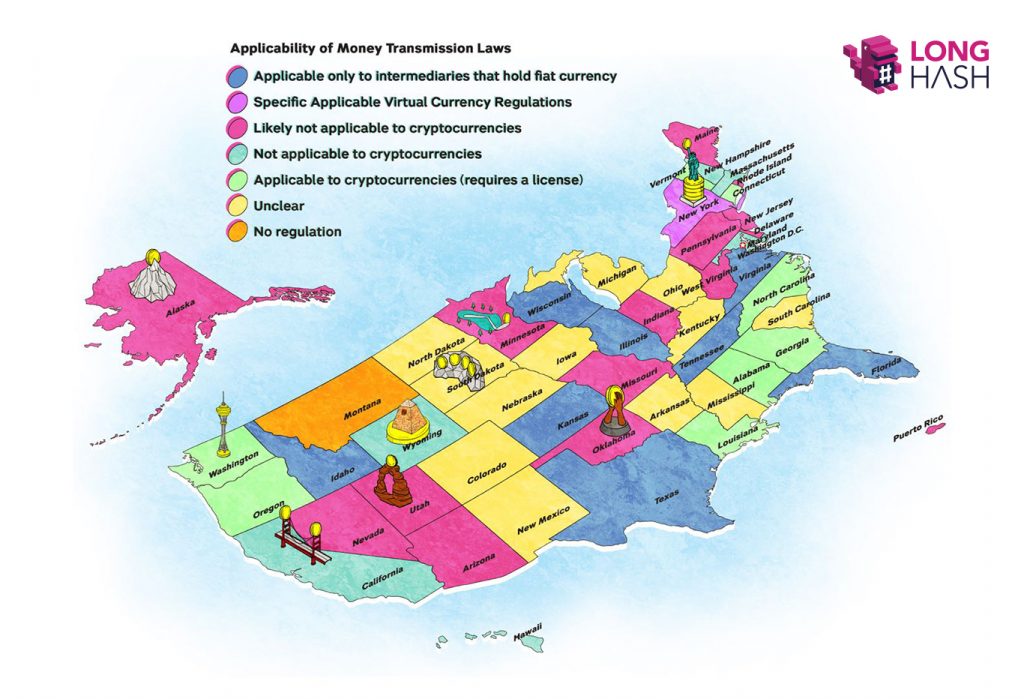
A tad better than “Unclear,” 11 additional states were deemed “likely not applicable to cryptocurrencies” in their money laundering laws, making a combined half of the country a decidedly risky place for those who exchange regular amounts.
“There was a time when it made a lot of sense for states to regulate money transmission,” legal researchers note in their examination, “or the business of transferring funds, currency, or other substitutes of money. In a pre-digital economy, almost all money transmitter businesses had to be physically located in the state where they offered payment or financial services for its residents, such as facilitating the payment of electric bills or exchanging currencies before a trip.”
Borderless
Digital currencies are almost by definition borderless, zapped around pocket to pocket through smartphones, laptops, desktops, tablets without thought about jurisdiction. Indeed, researchers underscore how “in the crypto era, state-by-state money transmitter rules just make things more complicated. There is no clarity about whether a company issuing a token, operating a wallet or facilitating crypto to crypto or crypto to fiat transactions needs a license in every state in which it could theoretically operate.”

Take, for example, the state of Michigan. It has been categorized as “unclear” for crypto users by Mr. Wales and Mr. Rego, and an anecdotal survey of news coverage seems to confirm that analysis. Just this month, in fact, these pages reported on the SEC action against Tokenlot, a Michigan-based outfit, touting itself as an “ICO superstore.”
The resolution of the case reads rather unsatisfying: “Without admitting or denying the SEC’s findings, Tokenlot, Kugel, and Lewitt consented to the SEC’s order and agreed to pay $471,000 in disgorgement plus $7,929 in interest, and they will retain an independent third party to destroy Tokenlot’s remaining inventory of digital assets,” according to Steven Peikin of its Enforcement Division.
The Wolverine State is a Prime Case in Point
Back in late 2017, another Michigander, Bradley Anthony Stetkiw, ran afoul of federal law while using P2P exchange Localbitcoins.com. The SEC accused the man of “buying, selling and brokering ‘deals for hundreds of thousands of dollars in bitcoin while failing to comply with money transmitting business registration requirements set forth in Title 31, United States Code, Section 5330,’” these pages also documented.
Readers could be excused, then, for placing Michigan into the column of states openly hostile to decentralized digital money. Not so fast. The state ranks in the top ten in terms of crypto usage (8th), and in its largest city, Detroit, “a bunch of cryptocurrency-based automated teller machines…are popping up in great number in liquor stores, gas stations, and cash-checking locations.” Go figure.

Complicating matters more, researchers also explain, “Today money transmitter businesses often have to apply for separate licenses within the states they operate, in addition to registering as a ‘Money Service Business’” with federal regulators. “This has made the cost of offering money transmission services across the country incredibly expensive and time-consuming. Though the cost and difficulty of obtaining a license varies by state, as of August 2018 every state except Montana requires at least some money service businesses to obtain a money transmitter license to lawfully operate.”
For Americans, “it’s not always clear how decentralized payment networks or the issuance of digital assets implicate existing regulations. Some states, for better (Wyoming) or worse (New York), have explicitly amended legislation to address digital assets, but for every clear piece of legislative guidance, there are many jurisdictions that leave entrepreneurs – and in some cases, digital currency users – in the dark,” they warn.
Do you think clearer guidance is needed on crypto usage? Let us know in the comments below.
Images courtesy of Shutterstock, Longhash.
At Bitcoin.com there’s a bunch of free helpful services. For instance, have you seen our Tools page? You can even look up the exchange rate for a transaction in the past. Or calculate the value of your current holdings. Or create a paper wallet. And much more.
The post Vague Laws Leave Crypto Users Confused in Almost Half of the US appeared first on Bitcoin News.
via C. Edward Kelso