Monday, October 1, 2018

Study Finds Growing Number of BATMs in Belgium and the Netherlands
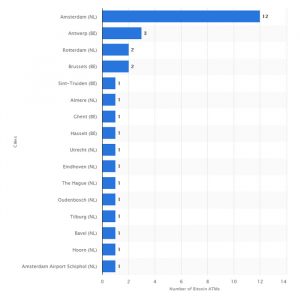
The number of cryptocurrency ATMs in Belgium and the Netherlands is growing, according to newly released data. Amsterdam is leading among major cities in the Benelux region, with 12 machines supporting digital coin transactions. Luxembourg, which is a global center of traditional finances, is lagging behind in terms of available crypto teller services.
Also read: A Guide to Building Your Own Crypto Mining Rig
Amsterdam Leading the Race With 12 Crypto Teller Machines
 The countries of the Benelux, the heart of Europe in many respects, are not only geographically close and culturally similar, but also enjoy a high degree of economic integration. The European crypto community would very much like to see the same level of cohesiveness when it comes to cryptocurrency adoption in the three states, all founding members of the European Union. Recently published data suggests, however, that they differ in at least one crypto-related aspect – the availability of teller services for digital cash.
A number of cryptocurrency teller machines have been installed in Dutch and Belgian cities in the last few years, with Amsterdam being the pronounced leader. Known for its numerous canals, Holland’s largest city may soon be famous for its bitcoin ATMs too – 12 are currently operational there, according to a report released by Statista. At least two of them support both purchases and sales of cryptocurrencies such as bitcoin core (BTC), ethereum (ETH) and litecoin (LTC).
As of August 2018, Antwerp, the second most populous metro area in neighboring Belgium, is a distant second behind Amsterdam, with 3 BATMs. Brussels, the Belgian capital, and Rotterdam, the second largest Dutch city, both have 2 devices selling digital coins. According to Coinatmradar, one of the machines in Brussels, which is a buy-only device, offers users the opportunity to purchase bitcoin cash (BCH) along with bitcoin core (BTC), ethereum (ETH) and litecoin (LTC).
Twelve other destinations in the two countries have at least one crypto teller machine. These include the cities of Sint-Truiden, Ghent, and Hasselt in Belgium as well as Almere, Utrecht, Eindhoven, Oudenbosch, Tiburg, Bavel, and Hoorn in the Netherlands. The Hague, the seat of the Dutch government, and Schiphol Airport, outside Amsterdam, each have one operational crypto ATM. The devices in the two countries are part of over 3,660 BATMs installed globally as of September 2018.
Luxembourg Lagging Behind
Neighboring Luxembourg, which has established itself as an international financial and banking hub, is not covered by the Statista report. The Coinatmradar database does not contain information about cryptocurrency teller machines on its territory either. According to another study, conducted earlier this year, 92% of its residents stated they did not possess any cryptocurrency. At the same time, 6% said they had bitcoin core (BTC), and 2% admitted they owned bitcoin cash (BCH), ethereum (ETH) and/or ripple (XRP). The data indicates a relatively limited spread and use of cryptocurrencies in Luxembourg.
In general, residents of the Benelux region own less digital cash than the average European consumer, Statista notes. The biggest number of crypto owners has been found among Dutch people this year, and in the first three quarters of 2017 there were approximately 44,000 bitcoin (BTC) trading transactions in the Netherlands. A poll conducted in the beginning of last year, before the public interest spiked with skyrocketing market prices, showed that 46 percent of the respondents in Holland had heard about digital currencies.
 As in most of Europe, the regulatory situation in the Benelux countries needs a more comprehensive approach. However, in the past year authorities in Belgium have mostly issued warnings about fraudulent schemes related to crypto investments. In June, the Dutch financial regulator, AFM, told institutions invested in cryptocurrencies that some of their activities might require licensing. The agency asked to be informed in advance about any expansion of their crypto product offerings. In March, the country’s finance minister called for the development of regional and international crypto regulations but the Dutch central bank stated in August that cryptocurrencies are not money. Luxembourg, which has attracted companies like Bitstamp, Bitflyer, and Revolut with its licensing regime giving them freedom to operate across Europe, has still to decide whether it wants to become a truly crypto-friendly jurisdiction.
Do you think the Benelux countries will eventually adopt favorable regulations for the crypto sector and the fintech industry? Share your expectations in the comments section below.
Images courtesy of Shutterstock, Statista.
Make sure you do not miss any important Bitcoin-related news! Follow our news feed any which way you prefer; via Twitter, Facebook, Telegram, RSS or email (scroll down to the bottom of this page to subscribe). We’ve got daily, weekly and quarterly summaries in newsletter form. Bitcoin never sleeps. Neither do we.
The post Study Finds Growing Number of BATMs in Belgium and the Netherlands appeared first on Bitcoin News.
via Lubomir Tassev
How to Install a Bitcoin.com Wallet for iOS Smartphones

Using cryptocurrency is the best way to understand cryptocurrency. One quick entrance into the ecosystem is to download an electronic “wallet” onto a smartphone. From there, Bitcoin.com Wallet users can then take it to what’s known as a faucet in order to receive some bitcoin cash (BCH) free and easy.
Also read: Colombia Crypto Exchange Asks New President for Banking Help
Install a Bitcoin.com Wallet for iOS
The nice thing about a Bitcoin.com wallet is its ease of use, its simplicity. Nearly three million folks have appreciated the clearly identifiable buttons and intuitive interface. Veterans appreciate those too as they go about evangelizing the money revolution that is cryptocurrency. An economy of space is immediately noticeable.

Step 1: Point your browser to Bitcoin.com. Prominently visible is Get a Free Wallet. Click that. Up will come a screen choice of phone platforms. Apple smartphone users will select “App Store.” Prompted to open the App Store, clicking “Open” will then reveal the “Bitcoin Wallet by Bitcoin.com.” There are reviews, a few pictures of its features, etc. Press “Get.”

Always Back Up Pass Phrases
Step 2: Like any other app, once it is installed, press “Open.” Bitcoin wallets will be ready for personalization. Since free BCH awaits in just a few clicks, press “Bitcoin Cash.” Click “New Personal Wallet,” and title it. In this example, it’s “Personal.” A wallet icon will appear to its left on the next screen rendition. Pressing that icon will bring up the balance screen. Notice the bar “Wallet not backed up.” This is a critical step in being financially free in the way BCH was meant. Take the time to follow the prompts, writing down the key words. Should anything happen to the wallet or phone, those words will be the key to unlocking the funds and creating or restoring a new wallet.

Step 3: The Bitcoin.com wallet is famous for its warnings, and they’re important to heed. Keep that backup phrase hidden, out of plain view. Of equal importance is realizing screenshots are not very secure. A hacked phone, for example, would be easy pickings if the key words were spotted. Other apps often take inventory of screenshots and photographs, remember.
 Free Bitcoin Cash
The Bitcoin Wallet has a few features beyond just sending and receiving coins. Users are also able to take advantage of games, read up on the ecosystem’s most important news, join a mining pool, and even check Satoshi Pulse for market action and charts.

Step 4: Click Free Bitcoin Cash. The next screen will be of the Bitcoin.com Faucet. In the good old days of bitcoin core (BTC), faucets were ways to baptize a newer user into the crypto space. Small amounts of BTC, which would later turn into fairly substantial sums as the coins appreciated in value, were distributed to get folks started. It is in that spirit Bitcoin Cash was created. It’s a chance to observe the power of being one’s own bank in real time. No identification needed. No government approval. No minimum balance. No credit check. And since the iOS wallet was already installed, it’s now a good time to get some BCH in there. Click “I have it!” To prevent abuse of the faucet, a somewhat unique identifier needs to be presented. In this case, it’s a Google sign-in. Follow the prompts.

Step 5: When prompted, press “How do I copy my address?” Once the receive BCH address is created, copy it, and then paste it in the field. Click “Receive Bitcoin Cash.” To also prevent bots and spammers, wallet users are asked to prove their human-ness. Click the appropriate pictures. And within seconds, the experience of close to one hundred thousand people all over the world happens, free BCH. Welcome to the revolution.
Have you downloaded a wallet yet? Ever used a crypto faucet? Let us know in the comments below.
Images courtesy of Shutterstock.
At Bitcoin.com there’s a bunch of free helpful services. For instance, have you seen our Tools page? You can even look up the exchange rate for a transaction in the past. Or calculate the value of your current holdings. Or create a paper wallet. And much more.
The post How to Install a Bitcoin.com Wallet for iOS Smartphones appeared first on Bitcoin News.
via Bitcoin.com
Regulations Roundup: Industry Leaders Want Clarity, Alliance Capitals Earns FINMA Warning

In recent news pertaining to cryptocurrency regulations, industry leaders have urged U.S. lawmakers to provide regulatory clarity or risk a crypto firm exodus, a Greek representative to the European Parliament has advocated for a lightweight cryptocurrency apparatus to avoid stifling innovation across the distributed ledger technologies industries, and the Swiss Financial Market Supervisory Authority has issued a warning regarding purported cryptocurrency company, Alliance Capitals.
Also Read: North Dakota Issues Orders Against Bitconnect, Magma, Pension Rewards
Industry Leaders Warn U.S. Lawmakers to Provide Clarity or Risk Crypto Exodus
 At a recent regulatory round-table held at Capitol Hill and hosted by congressman Warren Davidson, a number of cryptocurrency industry leaders warned lawmakers that a continued lack of regulatory clarity could lead to an exodus of firms seeking clear legislative guidelines in other jurisdictions.
Kraken co-founder and CEO Jesse Powell emphasized the disadvantaged position U.S.-based cryptocurrency firms and investors are in as a result of the current regulatory ambiguity, stating “Foreign companies are able to outraise their U.S. competitors and often whoever raises the most money is who wins. Not only are U.S. companies not able to raise enough to compete globally, U.S. investors are not able to invest in these global companies.”
Joyce Lai, a lawyer for Consensys, stated: “The competition around the world is real. But there is still time and opportunity for the U.S. to be a leader here.”
Congressman Davidson echoed the call for regulators to work toward providing clarity as quickly as possible, stating: “Legitimate players in the industry have a desire for some sort of certainty so we can prevent and prosecute fraud. I’m confident we can move forward and make this a flourishing market in the U.S. It’s an imperative for us to do, we did it well with the internet.”
Eva Kaili Advocates Minimal Regulation for DLT Industries
 Eva Kaili, a member of the European Council representing the Greek Panhellenic Socialist Movement, recently argued in favor of light regulation of the distributed ledger (DLT) industries at last week’s Concordia Summit in New York.
Mrs. Kaili insisted that regulations are a barrier to the speed of innovation that the DLT industries are capable of producing, stating: “One thing that we have in the E.U. and the U.K. — we have too many regulations that can at least delay the innovation. In blockchain, we tend to move very fast.”
“If it’s a fraud, it’s a fraud. If it’s not a fraud but it’s not following the rules, we gotta change the rules […] we don’t have an excuse not to explore the opportunities this technology gives us to solve global problems,” she added.
FINMA Issues Public Warning Regarding Alliance Capitals
 Switzerland’s financial regulatory body, the Swiss Financial Market Supervisory Authority (FINMA), has added Alliance Capitals, a firm purporting to offer a number of cryptocurrency services, to its warning list of “companies and individuals who may be carrying out unauthorized services and are not supervised by FINMA.”
Despite claiming to offer a trading platform, binary options, a venture investment fund focused on initial coin offerings, and a mining investment scheme, the services offered are hosted on third-party websites that prompt malicious content warnings.
Do you think that U.S. regulators will soon act to provide clear legislative guidelines for the cryptocurrency and DLT industries? Share your thoughts in the comments section below!
Images courtesy of Shutterstock, Wikipedia, finma.ch,
At Bitcoin.com there’s a bunch of free helpful services. For instance, have you seen our Tools page? You can even lookup the exchange rate for a transaction in the past. Or calculate the value of your current holdings. Or create a paper wallet. And much more.
The post Regulations Roundup: Industry Leaders Want Clarity, Alliance Capitals Earns FINMA Warning appeared first on Bitcoin News.
via Samuel Haig