Sunday, November 26, 2023

7-Day Crypto Snapshot: BLUR, APE, KLAY, and MINA Lead This Week’s Market Rallies

7-Day Crypto Snapshot: BLUR, APE, KLAY, and MINA Lead This Week's Market Rallies

In the last week, bitcoin experienced a modest increase of 2.7% against the U.S. dollar, while ethereum saw a rise of 6.5%. Concurrently, a range of other cryptocurrencies registered significant double-digit advances, notably the non-fungible token (NFT) marketplace Blur’s token BLUR, which soared by a significant 72% this past week.

17 Crypto Assets Record Double-Digit Growth

As of Sunday, November 26, 2023, the total market capitalization of the cryptocurrency sector stands at $1.43 trillion. This week, 17 distinct digital currencies achieved double-digit growth, with BLUR at the forefront with a 72% surge.

Trailing BLUR, apecoin (APE) escalated by 26.3%, and klaytn (KLAY) observed a comparable ascent of 26%. Further, mina protocol (MINA) climbed by 24.1%, while illuvium (ILV) rose 22.9% over the week, as per the data from coingecko.com.

Pursuing ILV, cryptocurrencies such as uniswap (UNI), sui (SUI), and bittensor (TAO) also experienced notable increases, ranging from 16% to 19.2%. Nevertheless, alongside these gains, several digital assets witnessed declines this week.

Celestia (TIA) experienced a significant drop, losing 21% over the week, and rollbit coin (RLB) decreased in value by 8.1%. Additionally, MATIC fell by 8%, and kaspa (KAS) suffered a 6% decline.

Other cryptocurrencies that didn’t fare well during this seven-day period include XDC, BNB, SOL, CAKE, and SHIB. On the flip side, the four digital currencies with the highest trading volumes this week were USDT, BTC, ETH, and USDC.

Within the $1.43 trillion crypto economy, bitcoin’s market value represents 51.2% of the total, while ethereum accounts for 17.5% as of November 26. In terms of 24-hour performance, the leading crypto gainers include SUPER, ETHW, ROSE, PRIME, and MAGIC, whereas the most notable losers are SNX, SEI, FTT, and PENDLE.

This week’s top-performing cryptocurrencies displayed less vigorous growth compared to the previous week, which witnessed several coins achieving triple-digit increases over a seven-day span.

What do you think about the week’s biggest gainers and losers in the world of crypto trading? Share your thoughts and opinions about this subject in the comments section below.


via Jamie Redman
Bitcoin’s Mining Difficulty Hits Record High With Sixth Consecutive Rise

Bitcoin's Mining Difficulty Hits Record High With Sixth Consecutive Rise

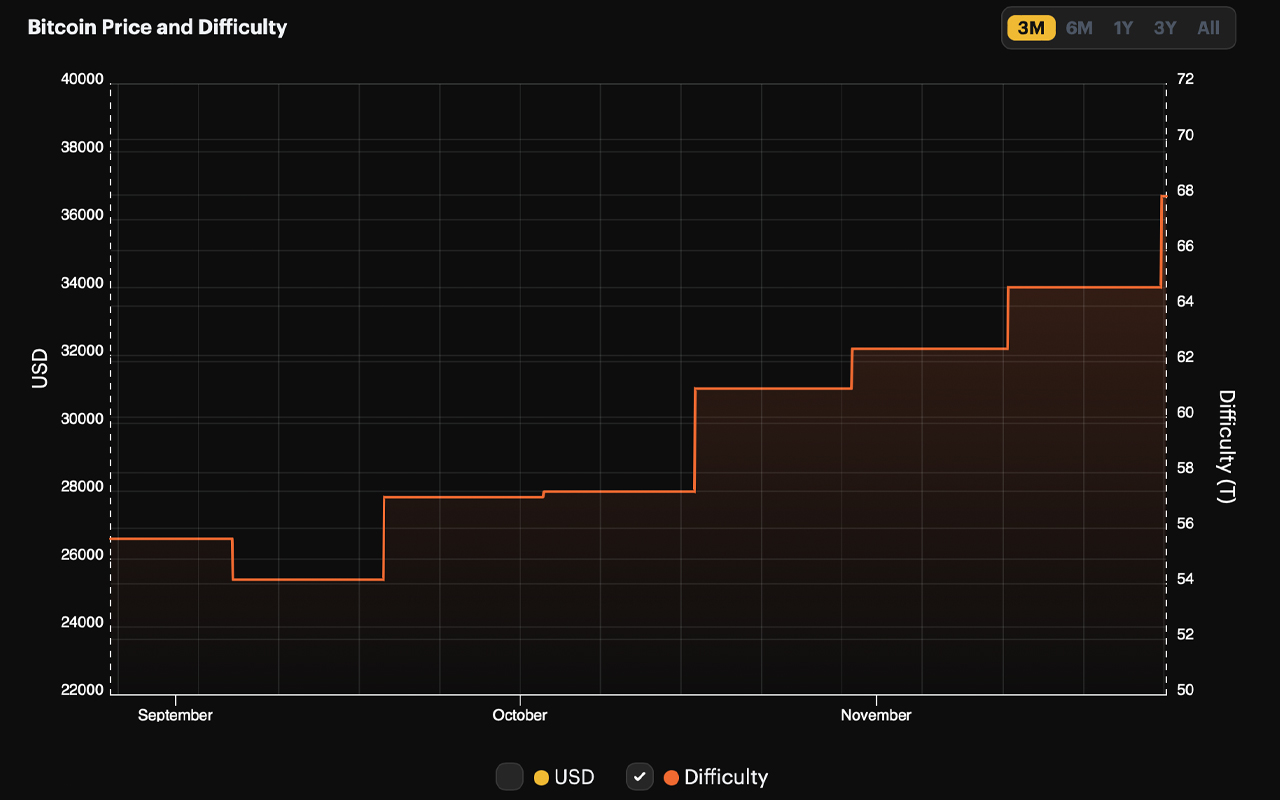
On November 25, 2023, the Bitcoin network marked its sixth consecutive difficulty rise, reaching a new peak at block 818,496. The difficulty soared by 5.07%, setting a record high of 67.96 trillion, a level that will persist until the next adjustment on December 9, 2023.

Bitcoin’s Difficulty Jumps 5% and Over 23% Higher During the Past 2 Months

The latest increase in Bitcoin’s difficulty, a 5.07% uptick, occurred on the evening of November 25 at block 818,496. This marks the sixth rise in difficulty since September 19, 2023, at block 808,416. Over the past 68 days, the cumulative increase stands at 23.27%. Despite this considerable rise over the two-month period, the network’s hashrate hasn’t shown any signs of slowing down, with miners consistently setting new records in this domain.

Bitcoin's Mining Difficulty Hits Record High With Sixth Consecutive Rise

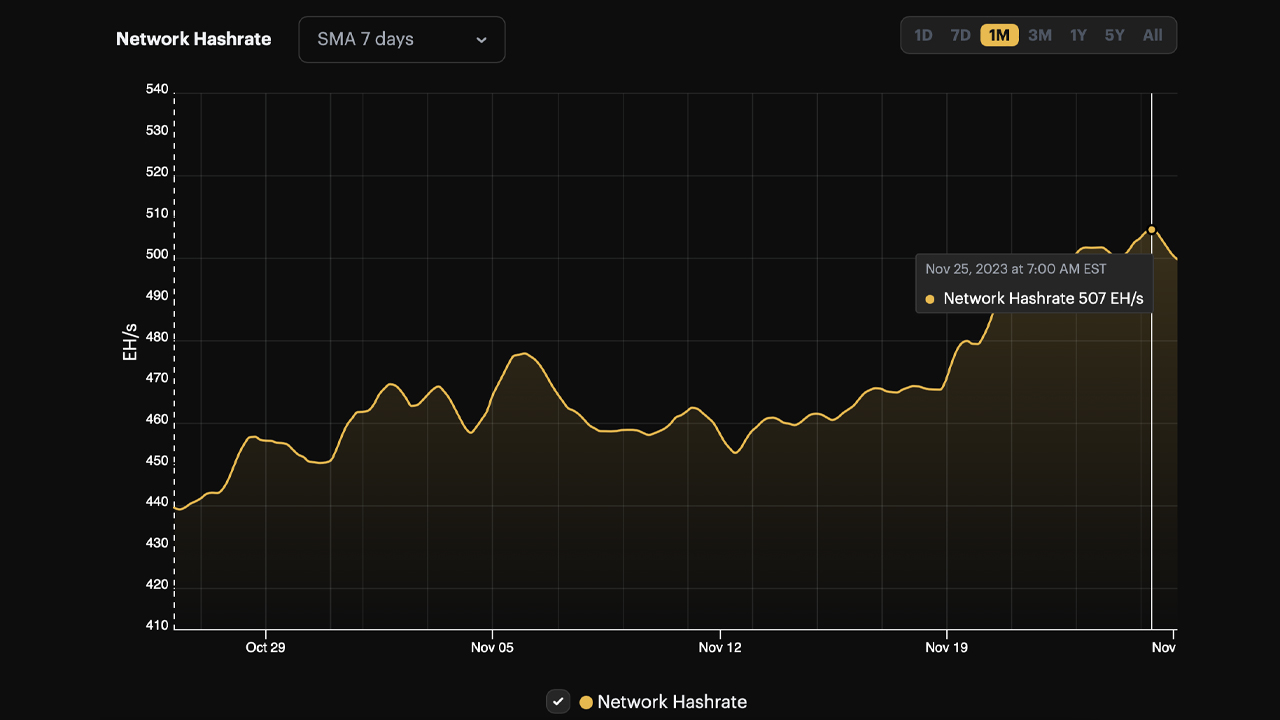
For example, at 7:00 a.m. Eastern Time on November 25, the hashrate’s seven-day moving average hit an unprecedented peak, reaching 507 exahash per second (EH/s). Despite the recent adjustment in difficulty, the hashrate continues to maintain a robust level of around 500 EH/s. With the difficulty now established at 67.96 trillion, bitcoin (BTC) miners are required to exert a significant amount of computational effort to discover blocks within this challenging high difficulty environment.

Bitcoin's Mining Difficulty Hits Record High With Sixth Consecutive Rise

As of this report, around 49 pools are contributing their hashrate to the Bitcoin blockchain, with the smallest among them offering 916 megahash per second (MH/s). The leading mining pool, Antpool, boasts a formidable 135.10 EH/s of hashpower, representing 27.23% of the overall total. Hot on its heels is the second-largest pool, Foundry USA, which commands 131.86 EH/s, amounting to 26.58% of the collective hashrate. Following these two giants in the mining arena are F2pool, Viabtc, and Binance Pool.

Time will reveal whether the recent difficulty adjustment, exceeding 5%, genuinely impacts miners’ activities, but current indications suggest the hashrate remains undeterred. In anticipation of the upcoming halving, mining entities have been actively expanding their arsenals with thousands of new machines, enhancing their fleet’s potency. The introduction of these newer, more efficient models, combined with the escalating BTC prices, has been a significant catalyst in driving both the hashrate and the mining pools that generate it.

What do you think about the network’s difficulty rising by more than 5% on November 25? Share your thoughts and opinions about this subject in the comments section below.


via Jamie Redman
End of an Era: CZ Steps Down, SEC Names More ‘Securities,’ as US Crypto Crusade Continues — Week in Review

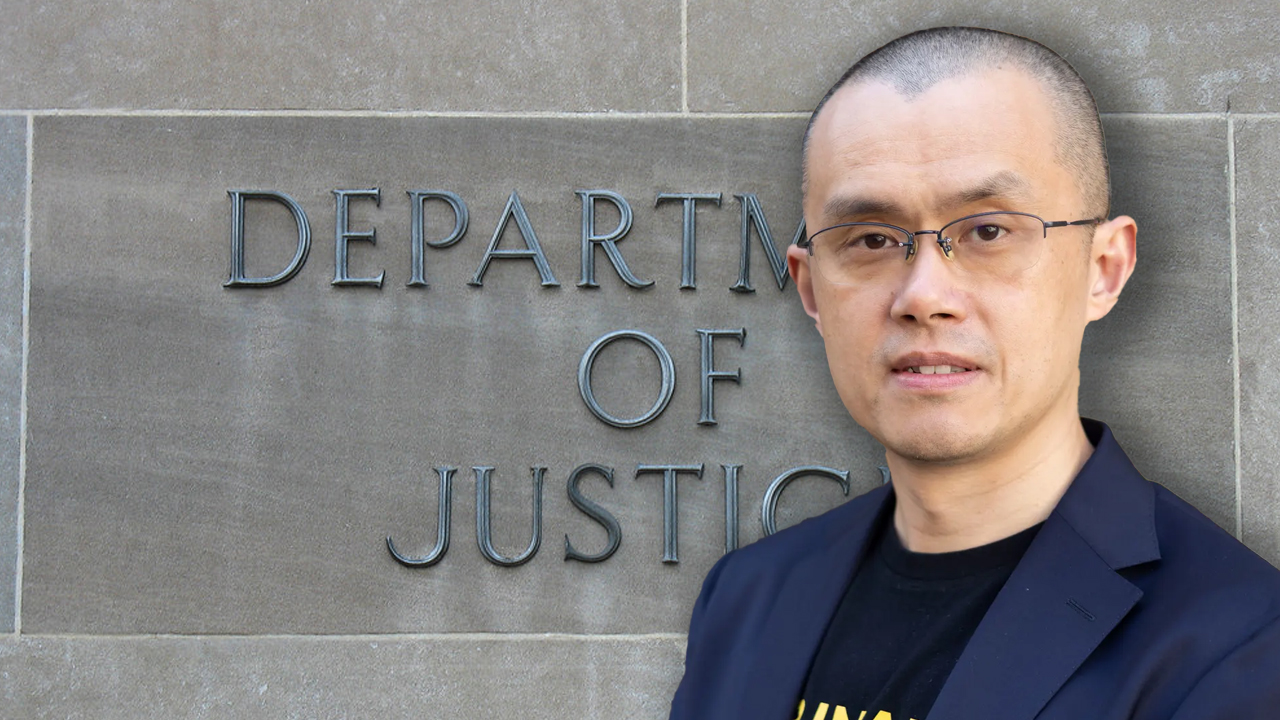
Bitcoin.com News reported this week that leading crypto exchange Binance will settle with the United States Department of Justice (DOJ) for $4.3 billion, related to breaching anti-money laundering and sanctions regulations. The well-known face of the exchange, and former CEO, Changpeng “CZ” Zhao, has stepped down as part of the plea deal. In other news, the U.S. Securities and Exchange Commission (SEC) has once again named crypto assets which it views as securities. This and more just below, in the latest Bitcoin.com News Week in Review.

DOJ Announces $4.3 Billion Settlement With Binance; CZ to Step Down as Part of Plea Deal

The United States Department of Justice (DOJ) has revealed a landmark settlement involving Binance, the world’s largest crypto exchange by trading volume. Under the agreement, Binance will pay $4.3 billion to settle with the law enforcement authority. This significant development was disclosed during a DOJ press briefing on cryptocurrency enforcement, which took place at 3:36 p.m. Eastern Time (ET) on Tuesday.

Read More

SEC Identifies 16 Crypto Tokens as Securities in Kraken Lawsuit

SEC Identifies 16 Crypto Tokens as Securities in Kraken Lawsuit

The U.S. Securities and Exchange Commission (SEC) has identified 16 crypto tokens as securities in its lawsuit against cryptocurrency exchange Kraken. Some of the alleged crypto securities were the same as those highlighted in the SEC’s lawsuits against Coinbase and Binance. Kraken’s CEO stressed: “We strongly disagree with the SEC claims, stand firm in our view that we do not list securities, and plan to vigorously defend our position.”

Read More

Bitcoin Mining Pool F2pool Acknowledges OFAC Transaction Censorship; Backpedals After Community Backlash

Bitcoin Mining Pool F2pool Acknowledges OFAC Transaction Censorship; Backpedals After Community Backlash

F2Pool, a Bitcoin mining pool, has admitted to filtering transactions coming from Bitcoin addresses flagged by the Office of Foreign Assets Control (OFAC). After the situation was discovered by 0xB10C, a Bitcoin developer, F2pool co-founder Chun Wang acknowledged that his pool was indeed applying this filter, announcing it would drop the censorship until there was consensus in the community on the issue.

Read More

Tether Announces 'Largest-Ever' USDT Freeze in History

Tether Freezes $225 Million in USDT After DOJ Investigation, Calling It ‘Largest-Ever Freeze of USDT

Tether has announced the “largest-ever freeze of USDT in history.” In collaboration with crypto exchange Okx, Tether froze $225 million in USDT following an investigation by the U.S. Department of Justice (DOJ). The tokens were allegedly linked to an international human trafficking syndicate in Southeast Asia responsible for a global “pig butchering” crypto scam.

Read More

What are your thoughts on this week’s stories? Be sure to let us know in the comments section below.


via Bitcoin.com

Nigeria Law Enforcement Nab Politician Who Laundered Funds Stolen From Crypto Exchange

Nigeria Law Enforcement Nab Politician Who Laundered Funds Stolen From Crypto Exchange

Nigerian law enforcement recently arrested a politician who is accused of laundering digital funds that were stolen from Patricia Technologies in May. CEO Hanu Fejiro praised the politician’s arrest and said the recovered funds will “go a long way to soothe Patricia users.”

The Politician’s Involvement in a Complex Crime

The Nigerian police have arrested a politician who is accused of seeking to launder digital assets that were stolen from the crypto exchange platform Patricia Technologies earlier this year. According to the police, Wilfred Bonse had fraudulently transferred more than $60,000 from the $750,000 in stolen funds to his bank account.

As reported by Bitcoin.com News in May, Patricia lost digital assets worth more than $2 million after hackers breached its platform. The theft left the crypto platform with a financial hole which forced Patricia to seek funds to refund affected users.

In his remarks after announcing the politician’s arrest, Prince Olumuyiwa Adejobi, the spokesperson for the Nigerian police, said:

Having registered his involvement in the complex crime. Wilfred Bonse, conspired in laundering the sum of Fifty Million Naira (N50,000,000) originating from the fraudulent diversion of Six Hundred and Seven Million Naira (N607,000,000) from Patricia Technology company’s account to his bank account through a cryptocurrency wallet.

The spokesperson, however, said investigations are still ongoing and vowed to bring those behind the hacking to justice.

In a post on X (formerly Twitter), Patricia praised Nigerian law enforcement agencies behind Bonse’s arrest. The CEO Hanu Fejiro said the recovered funds will “go a long way to soothe Patricia users.”

Meanwhile, the confirmation of Bonse’s arrest as well as the recovery of part of the funds came just a few days after Patricia said it had commenced refunding the first batch of users.

Register your email here to get a weekly update on African news sent to your inbox:

What are your thoughts on this story? Let us know what you think in the comments section below.


via Terence Zimwara

Saturday, November 25, 2023

BRC20 Token ORDI Dips 10% in a Week After a 319% Monthly Surge, Nears Record High

BRC20 Token ORDI Dips 10% in a Week After a 319% Monthly Surge, Nears Record High

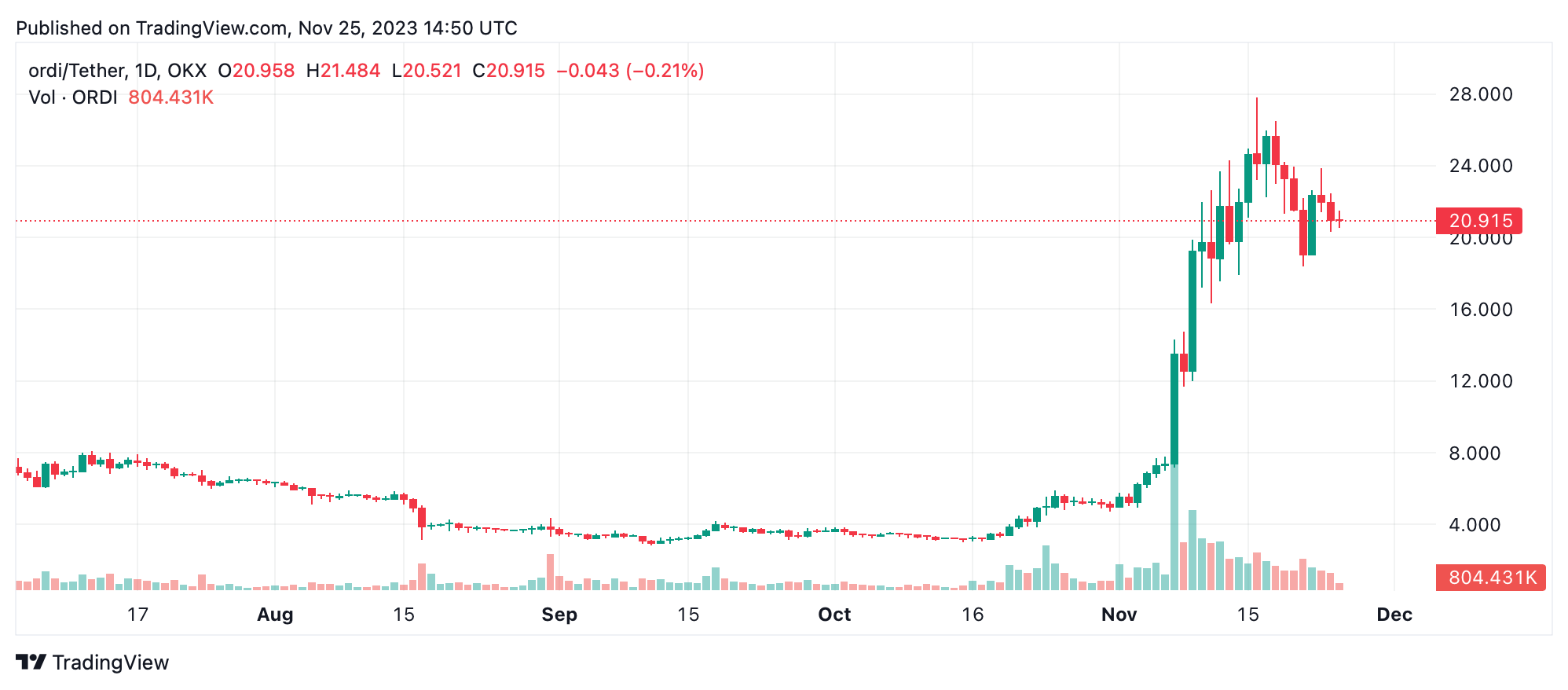
The price of the BRC20 token ordi (ORDI) slid more than 10% this week against the U.S. dollar after recording substantial gains over the three weeks prior. Despite the recent downturn, ORDI has risen over 300% during the last 30 days and it’s a touch over 25% away from surpassing its all-time price high.

ORDI Retreats 10% After 300% Monthly Gain, Sees Significant Trading Activity With Turkish Lira

At the end of the first week of November, ordi (ORDI) the BRC20 token built on top of the Bitcoin blockchain skyrocketed in value after Binance announced it would list the coin. This week, however, ORDI has dropped 10% in value over the past seven days and during the last 24 hours, it’s down 2.2%.

BRC20 Token ORDI Dips 10% in a Week After a 319% Monthly Surge, Nears Record High

ORDI’s market valuation on November 25, 2023, is just under a half billion at $446 million. This places ORDI in the 115th-ranked position among more than 10,000 crypto assets listed across 935 exchanges. Over the past day, ORDI has recorded $99 million in global trades, and interestingly, statistics from cryptocompare.com show ORDI has a great deal of trades associated with the Turkish lira, and even more so than its USDT pairs.

While ORDI is down 2.2% and more than 10% this past week, it has climbed awfully close to the pinnacle price it hit seven months ago on May 08, 2023. At that time, ORDI was trading for $28.52 per coin, and today, it is exchanging hands for $21.04 per unit. Moreover, over the past 30 days, ORDI has climbed 319% against the greenback.

Wallet or rich list statistics from the top ten ORDI wallets indicate that the crypto exchange Okx is one of the largest holders. The centralized exchange has a vast sum of ORDI tokens in the following addresses “bc1q8,” “bc1qg,” “bc1qz,” “bc1qn,” and “bc1qq,” among others. The largest ORDI holder today is the wallet “bc1qh” which commands 2,231,755 ORDI. The address is not flagged so the owner is unknown.

What do you think about ORDI’s market performance? Share your thoughts and opinions about this subject in the comments section below.


via Jamie Redman
BIS General Manager Agustin Carstens Touts Tokenization as Part of the Future Financial System

BIS General Manager Agustin Carstens Touts Tokenization as Part of the Future Financial System

Agustin Carstens, general manager of the Bank for International Settlements (BIS), has discussed tokenization’s significance in modernizing the current siloed financial system. Carstens stated that only through tokenization can the world move to a more interconnected and programmable financial system, where several central bank digital currencies (CBDCs) will be transacted seamlessly.

BIS Head Agustin Carstens Talks Tokenization as Origin of an International Unified Ledger

Agustin Carstens, general manager of the Bank for International Settlements (BIS), referred to the significance of tokenization as a key tech for building an interconnected financial system using central bank digital currency (CBDC). In a keynote speech at the CBDC & Future Monetary System Seminar in Seoul, Carstens explained how tokenization would allow the modernization of the current siloed financial system.

He stated:

Tokenization is a means of recording money and assets in a digital form on a programmable ledger. In practical terms, this means that users could transfer assets directly through programming instructions, rather than through intermediaries such as account managers who act on behalf of the user.

For Carstens, the tokenization of money and other assets and its integration on top of a “unified ledger” will help the current financial system to evolve, allowing a two-tiered currency system composed of wholesale tokenized CBDC and tokenized deposits to be implemented in several countries.

Carstens Blasts Outdated Regulatory Frameworks

According to Carstens, the technology necessary for this change is already here. Nonetheless, the regulations of each jurisdiction are hindering the advancements in this regard.

On this, Carstens declared:

The real challenge is to work out the legal and regulatory frameworks, the governance and the communication protocols needed for such a network of networks to operate. In short, we need to build the digital infrastructure.

However, he doesn’t think this will happen overnight and that every jurisdiction out there will join a hypothetical unified ledger. Nonetheless, the construction of protocols that allow interconnecting these systems can also help to achieve the desired interoperation goal.

He concluded that “the future monetary system needs wholesale central bank money at its core, complemented by tokenized commercial bank money and potentially other tokenized assets.”

Carstens has been a fervent proponent of CBDCs, stating before that their issuance would be the only way of “providing money in a form that meets the public’s needs and expectations.”

What do you think about Agustin Carstens’ thoughts on tokenization and CBDCs? Tell us in the comments section below.


via Sergio Goschenko

UAE Virtual Assets Regulator Says Islamic Coin Issuer Has ‘Cooperated Fully’

UAE Virtual Assets Regulator Says Islamic Coin Issuer Has 'Cooperated Fully'

Bored Gen DMCC, the issuer of islamic coin, has cooperated fully with the Virtual Assets Regulatory Authority’s ongoing investigation into the token’s issuance and distribution. Bored Gen, however, still needs to “secure appropriate approvals” before it undertakes to distribute the islamic coin (ISLM) in the Dubai market.

BG Undertook Remedial Measures

The United Arab Emirates (UAE) digital assets regulator, the Virtual Assets Regulatory Authority (VARA), recently revealed that Bored Gen DMCC (BG) — the issuer of islamic coin — had cooperated fully during its investigation into the issuance, marketing and distribution of the token. It added that BG had “undertaken remedial measures, including the implementation of adequate public disclosures for improved market assurance.”

However, in its Nov. 16 enforcement notice, the regulator said it had determined that the issues which are the subject of its ongoing investigation constituted “technical non-compliance.” The notice went on to state that BG still needs to “secure appropriate approvals” before it undertakes any distribution of islamic coin (ISLM) in the Dubai market. The notice added:

BG may continue business operations related to non-VA Activities, subject to maintenance of regular engagement with VARA and fulfilment of the necessary obligations including full compliance with all applicable regulatory requirements.

As previously reported by Bitcoin.com News, VARA blocked the sale and distribution of ISLM after a determination was made that BG lacked the authority to do so.

Issuer vs Developer Entity

Meanwhile, a statement issued on behalf of BG reveals that the organization is not the issuer of the token as stated by VARA. According to the statement, BG is in fact, a “developer entity” working to develop essential components such as the Haqq Wallet and Launchpad. It also asserts that the public sale of ISLM took place on the Republic platform, a regulated entity based in the United States.

In addition, the token sale is said to have adhered to Reg D and S for U.S. and non-U.S. investors respectively. On the other hand, Dubai was explicitly excluded from the sale, the statement added.

What are your thoughts on this story? Let us know what you think in the comments section below.


via Terence Zimwara